
Reimagining the Harlem Globetrotters
Zander Ealy’s project, “Reimagining the Harlem Globetrotters of the 50s and 60s,” won the Levey Family Research Prize, 2026.
My project, Reimagining the Harlem Globetrotters of the 50s and 60s: A Program Shedding Light on Forgotten Stars, began as the final project for Professor Noah Cohan’s Black Athlete in American Literature course. In that class, we studied Black athletes not simply as sports figures, but as cultural and historical figures whose stories reveal larger questions about race, visibility, labor, memory, and representation. That perspective shaped the direction of my project from the beginning.
As I thought about possible topics, I kept returning to a question that had come up repeatedly in class: what happens to athletes whose accomplishments were once widely recognized, but whose stories gradually fade from broader public memory? We studied many athletes who achieved remarkable things, often while navigating difficult racial and social conditions, yet whose names are no longer discussed with the same prominence. That idea stayed with me and led me to the Harlem Globetrotters.
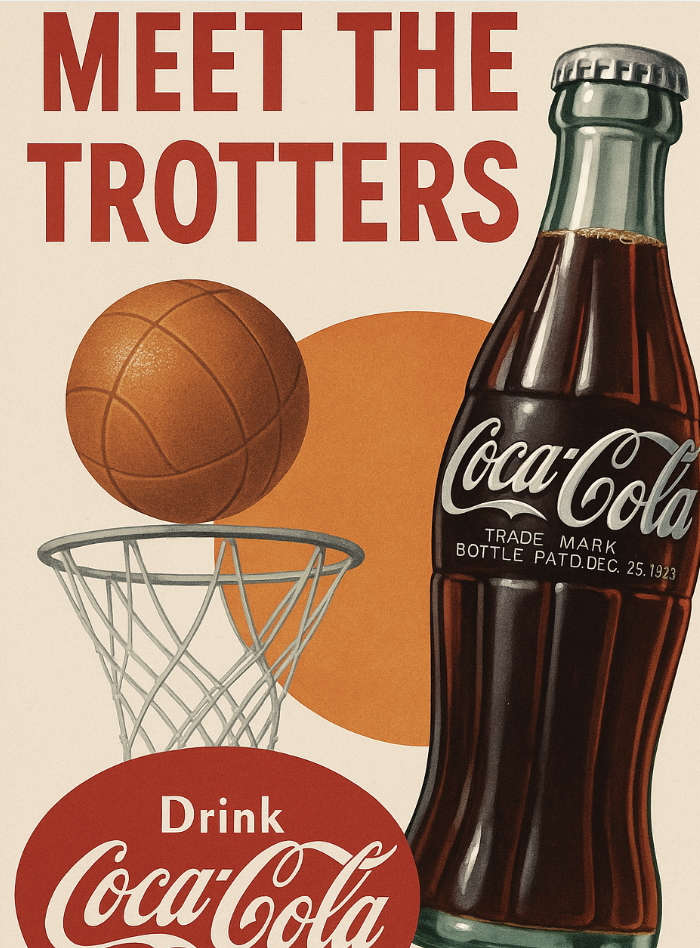
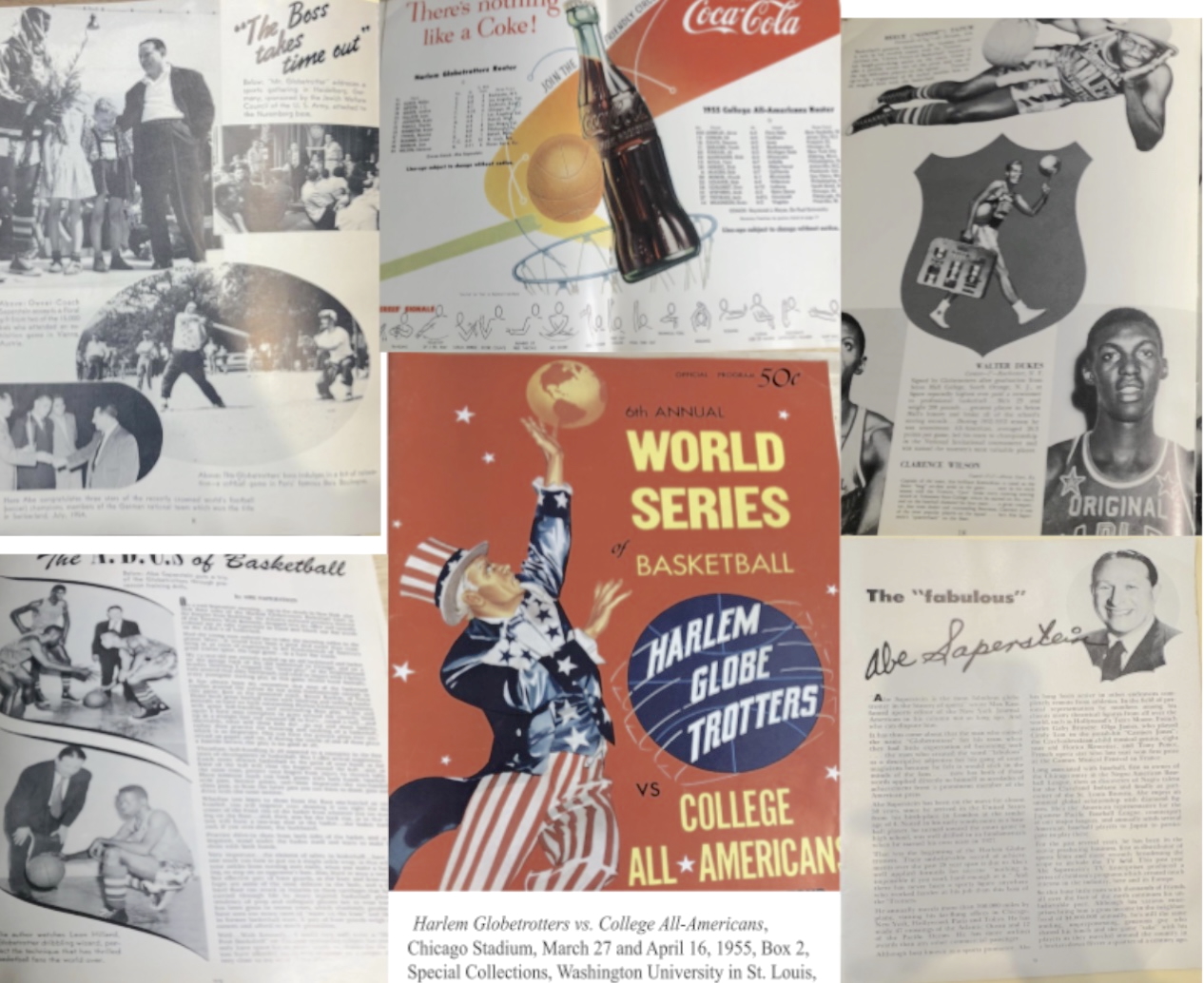
The specific foundation for my project came from a 1955 Harlem Globetrotters vs. College All-Stars official game program that I studied through the Lewis A. Levey Family Collection on Sports & Culture. At first, I was drawn to the program because the Harlem Globetrotters are such a recognizable part of sports history. But the more closely I looked, the more I noticed a striking imbalance. The players were present in the program, but only in a limited way. Most were listed with brief details such as name, hometown, height, and position, yet readers were given very little sense of who these athletes were as individuals. In contrast, far more space was devoted to the Harlem Globetrotters as a brand and especially to owner Abe Saperstein.
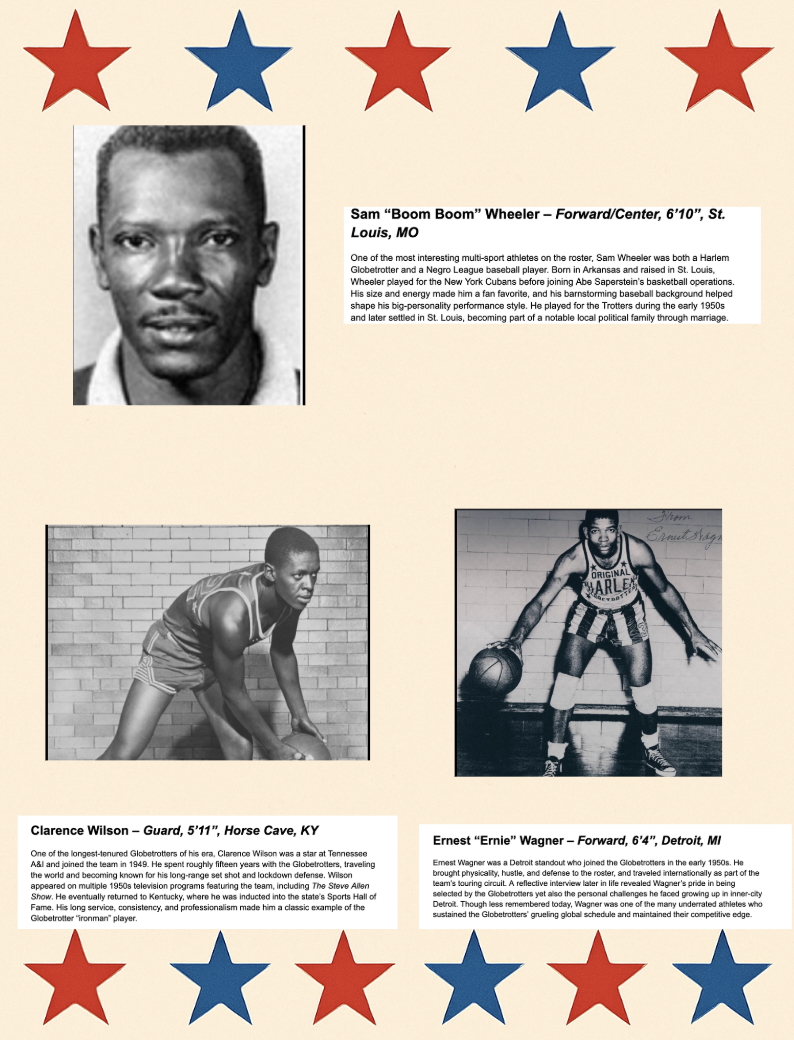
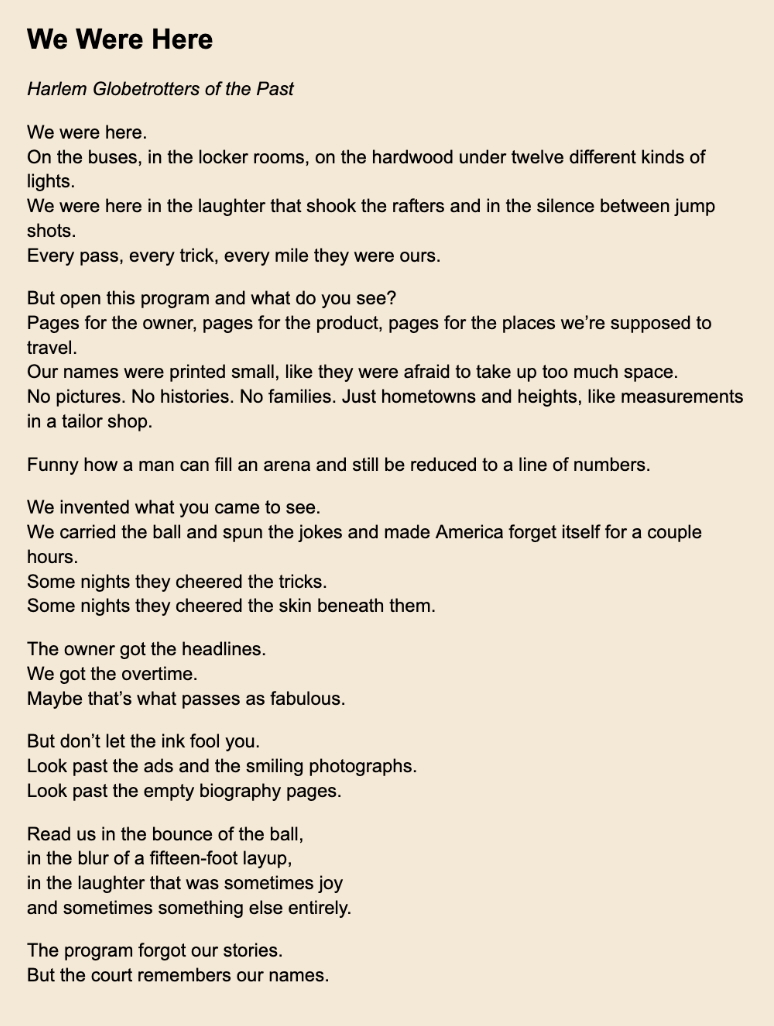
That imbalance became the core of my project. I wanted to reimagine the program in a way that restored more narrative, dignity, and individuality to the players whose labor and talent made the team’s success possible. Rather than leaving them in the margins of the booklet, I wanted to bring them closer to the center.
My thinking was also influenced by William C. Rhoden’s Forty Million Dollar Slaves, which challenged me to think critically about the position of Black athletes in American culture. One of the ideas that stayed with me from that book is the tension between visibility and recognition.
Black athletes can be celebrated, watched, and commercially valuable, while still not being fully remembered or understood on their own terms. That framework helped me think differently about the original program. The players were visible, but they were not fully seen.
As a student-athlete on the football team at WashU, that question felt especially meaningful to me. Being an athlete gives you an understanding of the discipline, work, and sacrifice that come with sport. But this project reminded me that an athlete’s legacy is not shaped only by performance. It is also shaped by documentation. Who gets remembered, how they are remembered, and what gets left out all help determine the history of sport itself.
Another major part of this project was that it was my first time working with an archive. Before this, I had never done archival research, and the experience had a real impact on me. I had often thought of research mainly as gathering information, but working with archival materials taught me that research is also about interpretation, patience, and learning how to pay attention to absence as much as presence.
That became especially clear as I tried to learn more about the individual players. In some cases, it was difficult to find substantial information or even professional images. That absence became part of the argument of the project itself. History is shaped not only by what gets preserved, but also by what is allowed to fade. My redesigned program tries to push back against that process by giving these players more presence than the original program did.
One example that stood out to me was Reece “Goose” Tatum, one of the most influential early Globetrotters. Although he helped define the team’s style and legacy, he was absent from the 1955 roster even while his image still appeared elsewhere in the program’s advertising. That contradiction captured much of what interested me most: the way Black athletic labor and creativity could remain useful to a larger institution even while the individual behind it was reduced or overlooked.
Working with the Lewis A. Levey Family Collection on Sports & Culture made history feel more active and human to me. It showed me that archives are not just places where documents are stored. They are places where forgotten people can come back into view and where familiar stories can be reconsidered. That is what made this project meaningful to me. It became not just a redesign of a historical program, but an effort to think more carefully about who gets remembered in sports history and why.