
A Tribute to Gaylord Music Library
The Gaylord Music Library will close in May 2026 after sixty-six years. Completed in 1960, the library was a significant milestone in WashU’s growth and has since served as the focal point for the preservation, understanding, and study of music history and material culture. Funds for the music library were donated by Catherine Gaylord in memory of her husband Clifford W. Gaylord who served on Washington University’s Board of Directors from 1941 until 1953.
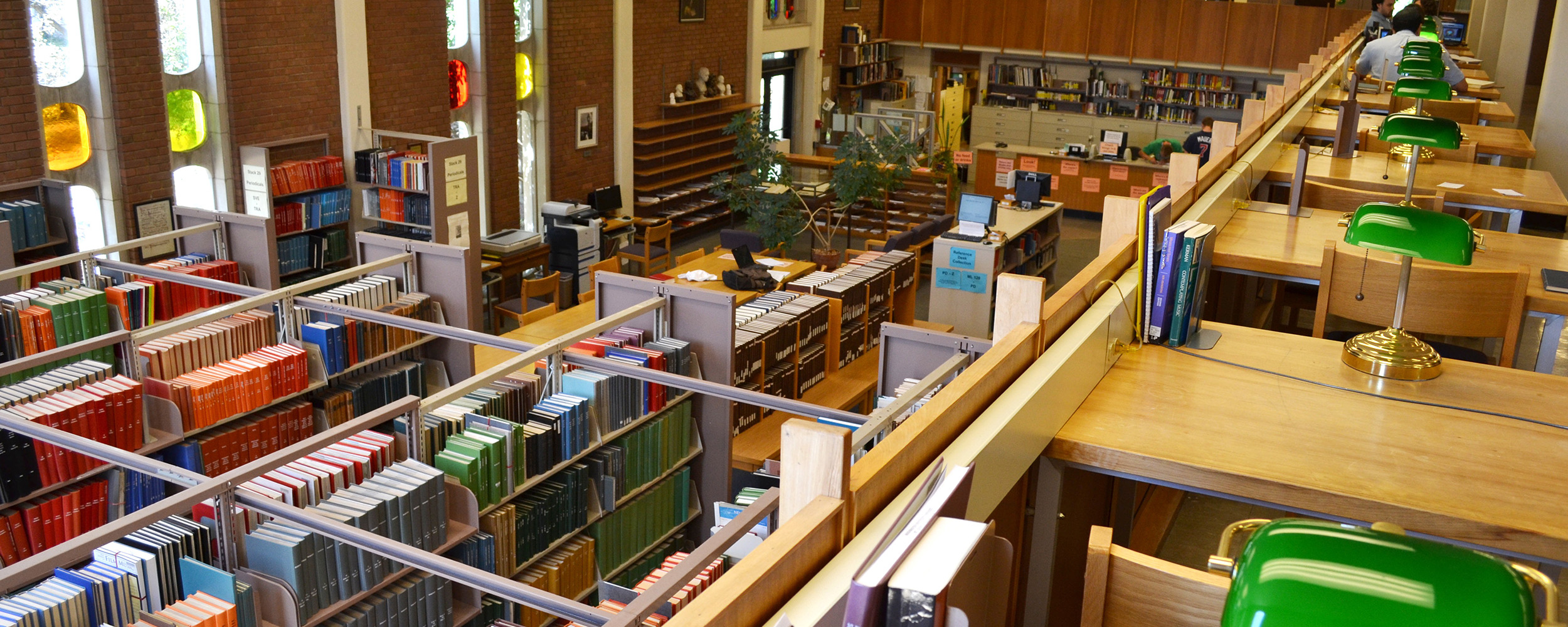
News articles from the time celebrate it as the only music library in the Midwest and one of the very few in the United States (“Gaylord Library at W.U. Among Nation’s Top Ten” says a headline in the St. Louis Globe-Democrat). Designed as a spacious, two-level study area with open stacks and a “modern Gothic atmosphere,” the secluded and attractive setting of Gaylord Library made it a beloved study spot for WashU students for more than six decades.
Architectural Importance
Gaylord Library’s architectural distinction, along with its historical value and influence, has garnered widespread recognition. The two-story library was designed by St. Louis architects Eric Smith and Robert Entzeroth to represent a mix of the modern and the classical, “a contemporary approach to the traditional Tudor Gothic found on this campus,” as noted by WashU musicologist Lincoln B. Spiess in 1961 (“A New Music Library in St. Louis”). “Especially significant is that, I reckon, Gaylord was the first attempt in WashU architecture to re-interpret collegiate Gothic for the twentieth century,” said Mark Scharff, Music & Special Collections Catalog Librarian.
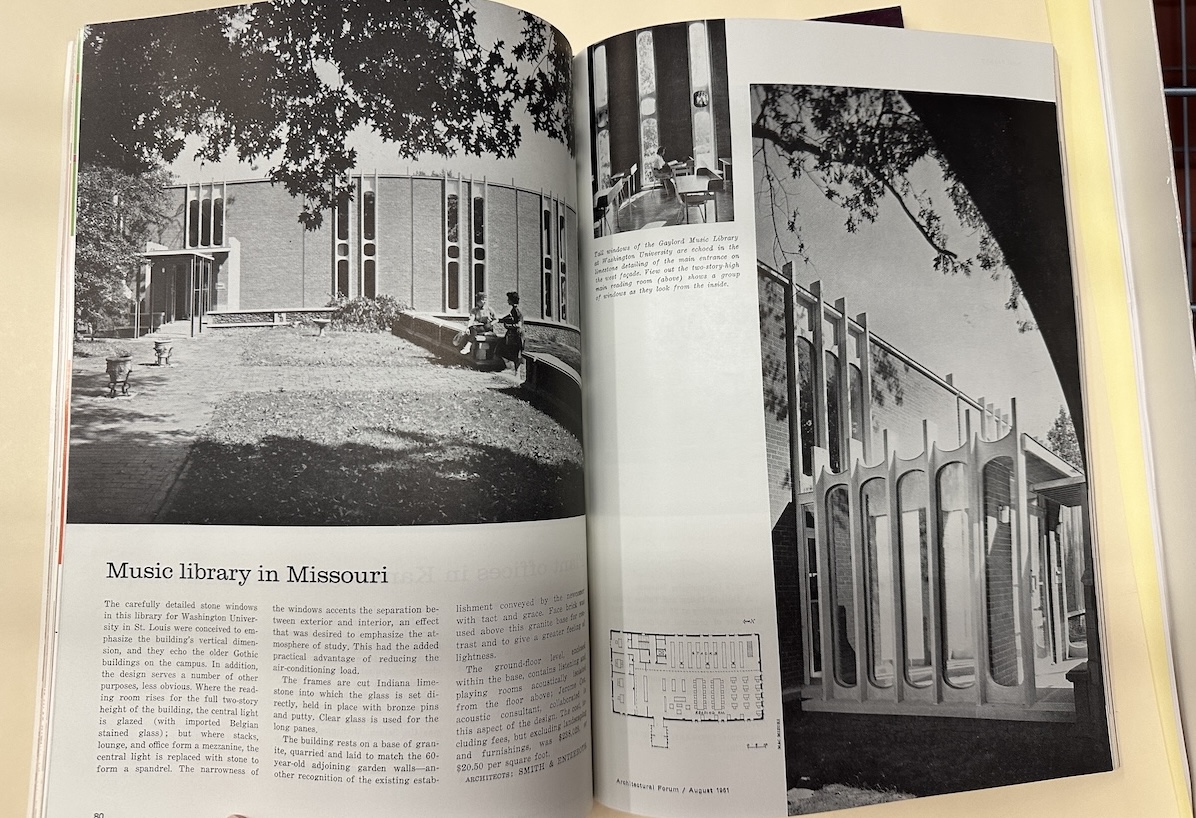
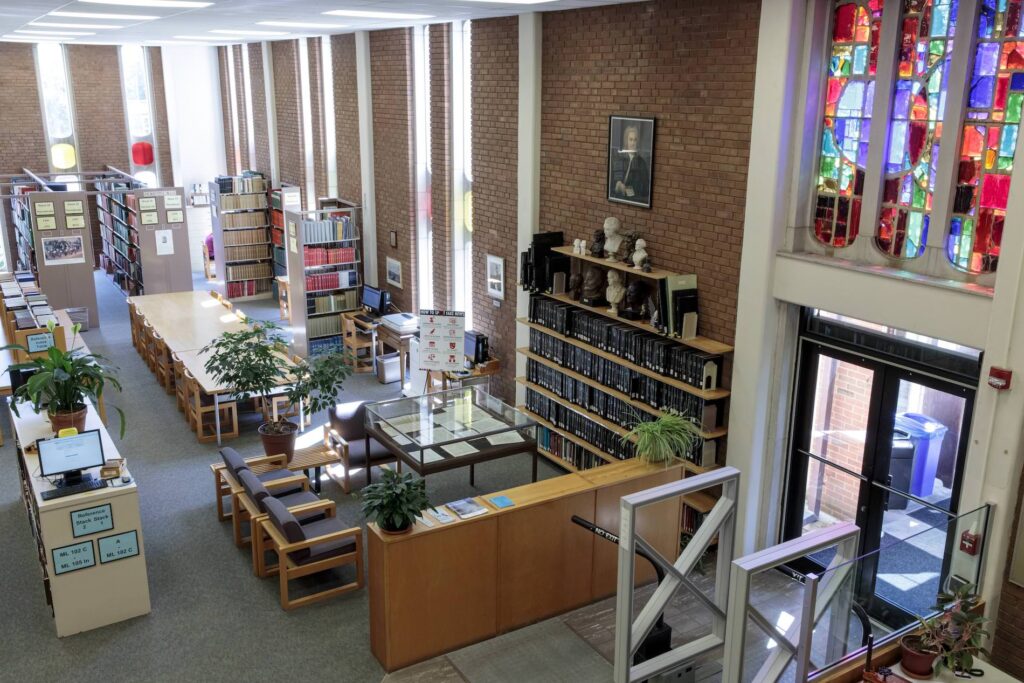
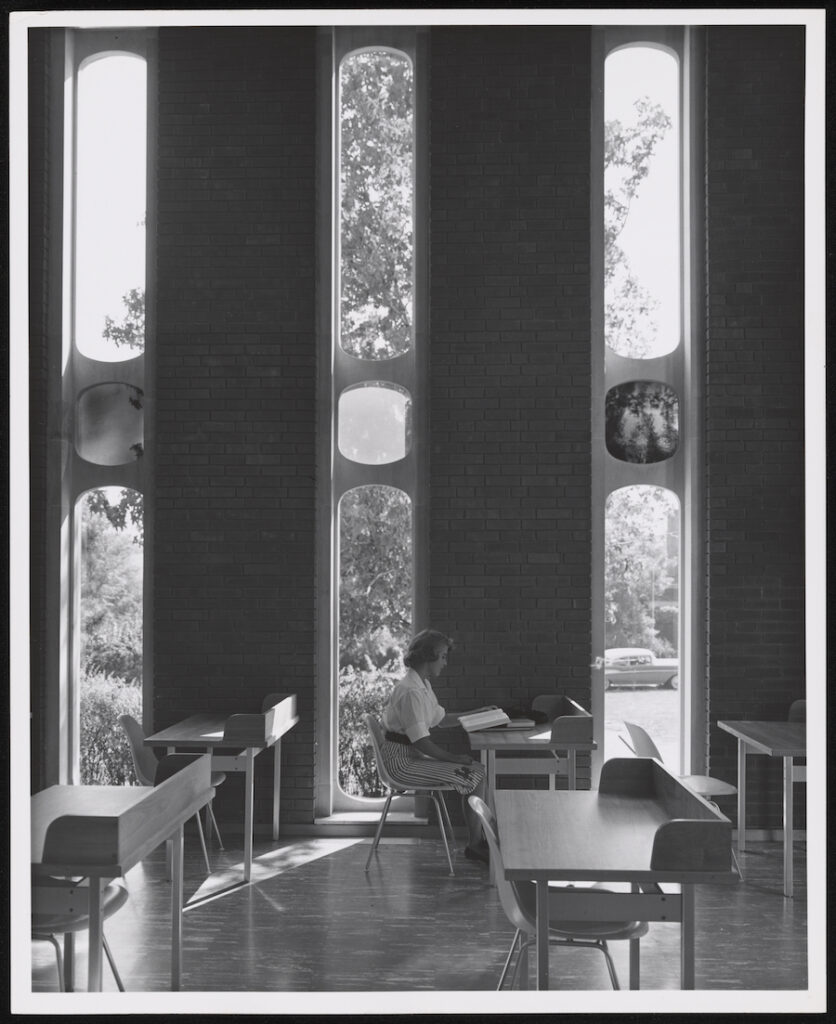
The intention was to achieve the atmosphere of a “self-contained music campus” with a covered walkway connecting the library to Blewett Hall, home of the Department of Music. Other striking and iconic architectural features of the building include a series of tall and narrow glass windows with limestone frames that line the walls of the first floor reading room, the elegant mezzanine level with study desks, and the eight-feet high Belgian stained glass windows above the entrance overlooking the reading room.
The stained glass window panels were designed by Fred Conway, an artist and faculty member at WashU and constructed by the Emil Frei Company of St. Louis. The three stained glass windows represent both a scientific and an aesthetic achievement: they helped get rid of the problem of the glare of sunlight in the room, enhanced the appeal of the library, and were made using a special resin compound on glass that was remarkable for its time (Plastics World, 1963).
The Growth of Music Collections
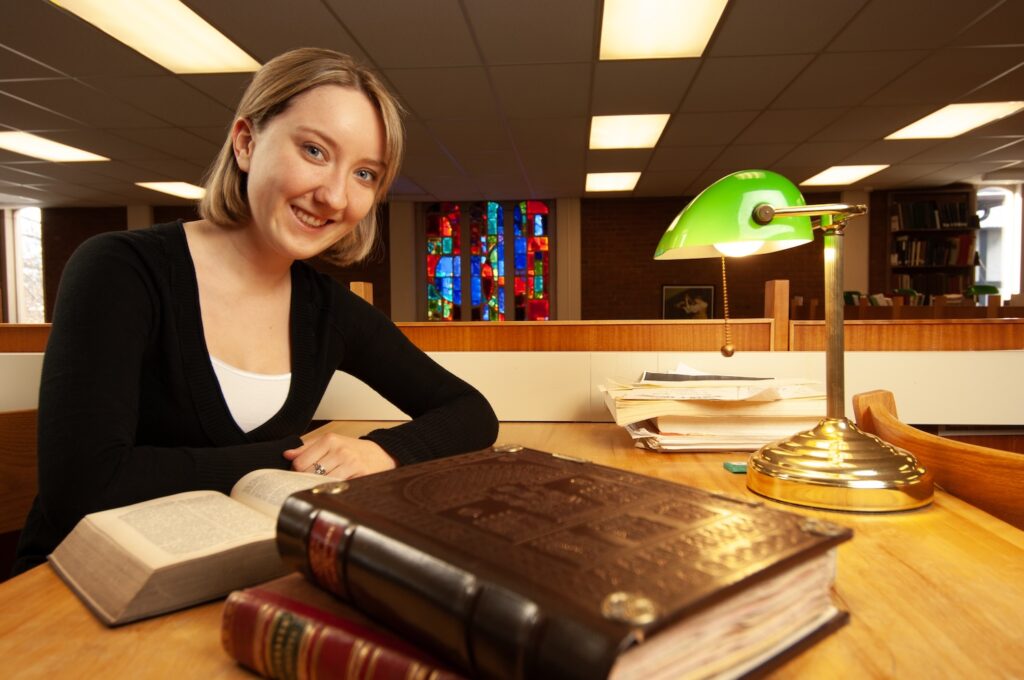
The library began with 25,000 volumes and by the end of the 1960s had expanded to 50,000 volumes. Today Gaylord’s collections hold approximately 55,000 music books and periodicals, as well as 115,000 recordings and tapes. Its archives comprise a vast collection of music manuscripts, sheet music, and rare books and scores that have supported music education and research at WashU and beyond.
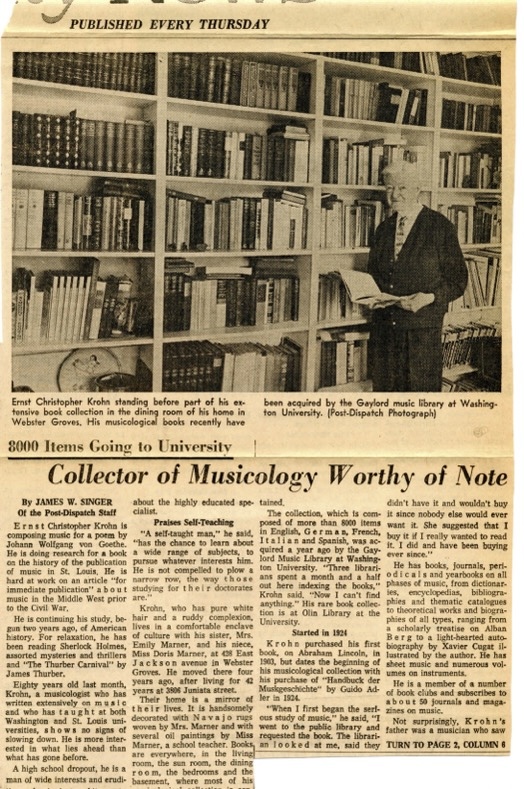
The special collections at Gaylord Music Library have grown through the dedicated efforts of music librarians, music enthusiasts, and collectors, who include musicians associated with St. Louis, WashU musicologists, and alumni. Its origins, however, trace directly to WashU professor and musicologist Ernst C. Krohn, whose sale of his extensive collection to the university in 1966 established the foundation of the library’s archival holdings.
The Ernst C. Krohn Musicological Library contains 9,000 volume collection of books on music history and musicology, musical Festschriften as well as sheet music, hymnals, and many rarities that showcase American popular music and St. Louis music history.
Scharff describes the acquisition as a “major milestone that brought to the library the core of its sheet music collection.” The library’s sheet music archives number approximately 100,000 pieces of sheet music dating from the 1820s to the 1950s with compositions by Irving Berlin, Noel Coward, and others.
Through the decades, Gaylord Music Library has acquired an exceptional range of collections spanning several centuries and genres, from the music of Greek and Roman civilizations to twentieth-century masterpieces.
Its holdings include one of the largest collections of nineteenth- and twentieth-century guitar music, alongside music manuscript collections connected to St. Louis as well as WashU faculty and alumni. The library also preserves manuscripts and performance scores by composers from the late seventeenth through the early twentieth centuries, in addition to works by mid-twentieth-century American composers. Among its most notable treasures is a collection of more than 300 first and early editions of Mozart and Beethoven, complemented by numerous score editions of Johann Sebastian Bach, Felix Mendelssohn, and Robert Schumann, among others.
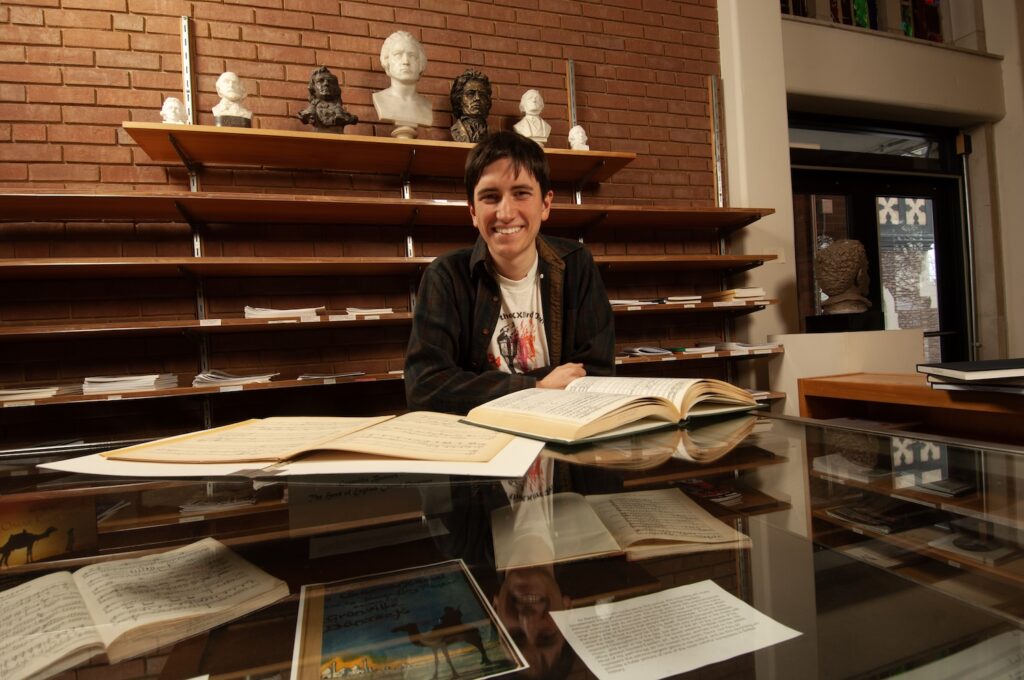
In addition, the library features extensive collections of film scores and musical theater anthologies, as well as opera scores and recordings, including several hundred librettos in French, English, and German.
Collections and scholarly resources were strategically acquired by music librarians to meet the research and educational needs of faculty and students. “Supporting the research needs of faculty and students has always been a strength and high priority here,” said Scharff.
Dolores Pesce, Avis Blewett Professor Emerita of Music, echoes the sentiment. “During my long association with the WashU Music Department, I have always seemed to head first to Gaylord when I arrived on campus. From my first visit to Gaylord in 1982, I found a rich reference collection on medieval music and theory, which allowed me to continue my early music research with ease. As I developed a second research area in the late nineteenth century, dedicated librarians Mark Scharff and Brad Short helped me locate sources outside of WashU and stood ready to acquire needed materials for Gaylord itself,” said Professor Pesce.
Gaylord’s collections have been extensively utilized for all levels of music education from vocal studies, piano, guitar, violin, cello, orchestra and opera to graduate and undergraduate courses in musicology, theory, and composition.
Professor Pesce observed, “Gaylord’s special collections were a boon for my graduate course that taught students how to identify, classify, and analyze sources. For example, we tackled an eighteenth-century choir book of Mexican provenance and manuscripts of Prussian composer Johann Friedrich Eduard Sobolewski who had settled in St. Louis in 1860. These sources provided invaluable training for my students, as well as intellectual stimulation for them and me.”
Music Processing Archivist Kylie Flynn, who is processing Gaylord materials for removal and preservation, said that the library closure has brought many unseen treasures to light, which capture the formative years of Gaylord Music Library and its enduring legacy. “The collections that I’ve working on processing have so many hidden gems that range from several professors’ old music courses syllabi and lecture notes, St. Louis local history, early twentieth century Met Opera playbills, and even WWII correspondence from one of the professors,” said Flynn.
Every part of Gaylord Music Library’s comprehensive collection of music books, scores, sound recordings, videos & DVDs, and research collections will remain accessible. Once relocation is complete, music collections will be housed in Olin Library, West Campus, and Special Collections.