
Reflections from an Archive Practicum Student
I contacted Miranda Rectenwald, curator of local history with the Julian Edison Department of Special Collections, as part of a harried cold emailing session to several different St. Louis archivists. I needed to get experience in archives management for my master’s degree in library and information science from Indiana University, but all of my school resources are in Bloomington. My mentor assured me that there were tons of archives in St. Louis and all I needed to do was start reaching out. Thankfully, Miranda got back to me and offered me a collaborative exhibit project for the LGBTQ+ nonprofit PROMO’s 40th anniversary.
I was excited to see the local history collection’s Mapping LGBTQ+ St. Louis project, which is why I reached out to Miranda in the first place. Mapping LGBTQ+ St. Louis is an online mapping project about queer existence in St. Louis, which connected back to what I wanted to accomplish with my master’s degree. I became interested in archives because of my own queer identity. My goal was to prove that we’d always been here. I wanted to gather firsthand evidence of LGBTQ+ history and reinsert us into the narrative.
Diving Into History
When beginning my archival research for the PROMO exhibition, I was unsure how much I’d find right away. But, as I made my way through the collections at WashU and traveled over to the PROMO related collections with the Missouri Historical Society, I realized I was at the center of a larger community. PROMO had a long history of dedicated members who had donated their work to various archives across St. Louis. By the time I arrived at the PROMO collection with the State Historical Society of Missouri, I realized I’d gathered more than enough to create a narrative.
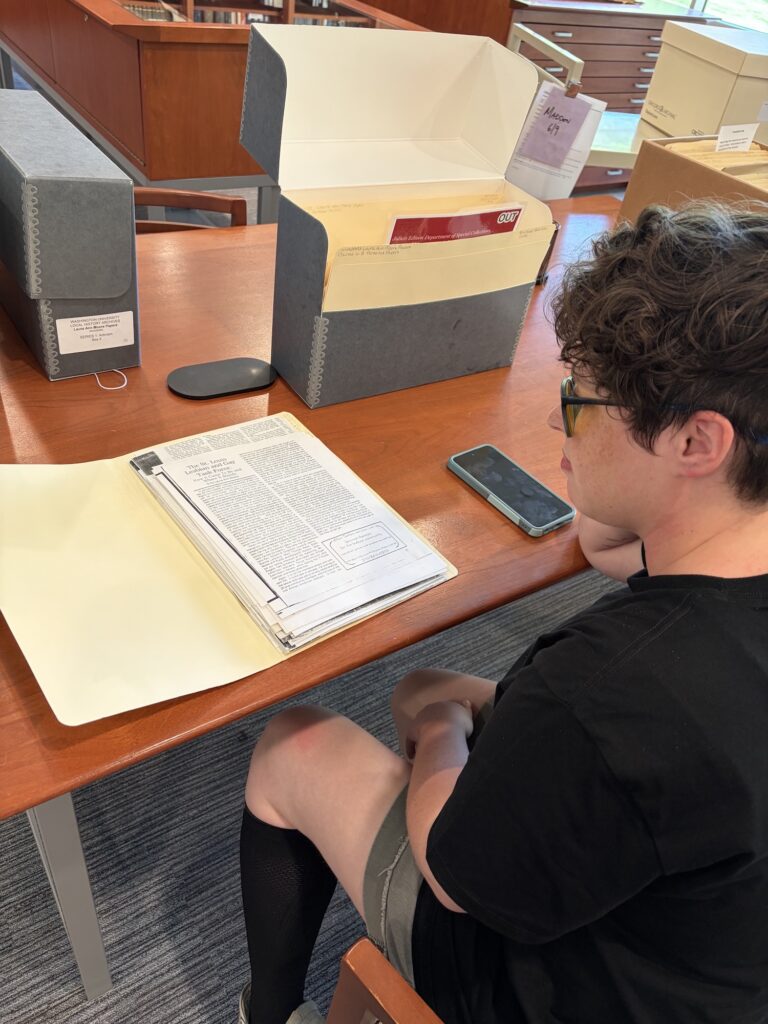
PROMO was founded in 1986 as a grassroots incentive to lobby for privacy rights in Missouri. 1986 was the year that Bowers v. Hardwick, a U.S. Supreme Court case from Georgia, proved that gay and lesbian relationships were not protected by existing privacy laws. Sodomy laws had been the main way to criminalize LGBTQ+ people, but now it was clear that there was nowhere to hide. PROMO stepped in as a way to argue for privacy in Missouri on a legal level, and also offer a safe community filled with educational resources.
Finding the Ghosts
I am not really from St. Louis. I lived most of my life in Virginia, surrounded by places like Colonial Williamsburg and the Smithsonian. I even worked as a ghost tour guide in Williamsburg. American history has always surrounded me, but I have rarely seen queer people like myself within it. We are ghosts within the broader narrative, there but not really, afraid to be open about our existence. It feels as though whatever bits of historical evidence modern queer people can pick up are lifted to the light and examined from every angle. We want so desperately to see ourselves reflected there.
PROMO’s history was loud in comparison to what I was used to. They have developed a history of lobbying for the rights of the LGBTQ+ community, which has required them to be direct about who they are. They have blazed a path across Missouri’s history and made it clear that our existence and rights cannot be ignored. The archives they helped to develop led me to understand that I am not alone in my desire to lift up the stories of the LGBTQ+ community. In developing an exhibit for PROMO, I was not only able to highlight the work they’ve done, but I was also able to connect to the people who came before me.
About Special Collections
This practicum is part of the WashU Library’s ongoing effort to ensure that local LGBTQ+ history is preserved and available for study. If you have files, photographs, recordings, or other items that document LGBTQ+ life in the St. Louis area, contact Miranda Rectenwald, curator of local history to talk about ways this history can be preserved for future generations.
All researchers, regardless of university affiliation, are welcome at Special Collections. Please contact [email protected] for more information.
The pop-up exhibit celebrating the 40-year history of the organization will debut at PROMO’s gala, URBANAIRE: Shades of Resistance, September 26, 2026.
Layne Madden is a MLIS graduate student at Indiana University. They completed an academic practicum with the department of special collections, June–September, 2026.