
Building an Ethical, AI-Competent 3D Library of Human Remains
In 2022, Science published the article “Medical, scientific racism revealed in century-old plaque from Black man’s teeth.” It detailed how the Terry Collection—one of the most studied collections of human remains in the U.S.—was largely built from vulnerable populations in St. Louis, more than fifty percent of whom were Black and likely did not consent to being included in the collection. While most of the Terry Collection was donated to the Smithsonian, remains of individuals from it continued to be unknowingly studied in Washington University classrooms. Repatriation efforts are currently underway (see “Bones in Our Basement”). As institutions worldwide rightfully retire human remains collections for ethical reasons, a critical question emerges: How do we build an ethical future for studying human variation?
As part of the 2026 Digital Transformation Research Corps, principal investigators Sarah Baitzel, associate professor of archaeology, and Thomas Cody Prang, assistant professor of biological anthropology, explored possibilities for ethically enabling the future study and teaching of human skeletal remains. The ten-week summer project was led by WashU’s Digital Intelligence & Innovation Accelerator (DI2) and brought together two undergraduate student developers, a graduate student designer, a project manager, as well as me, the project’s technical lead, and a 3D data advisor from WashU Libraries.
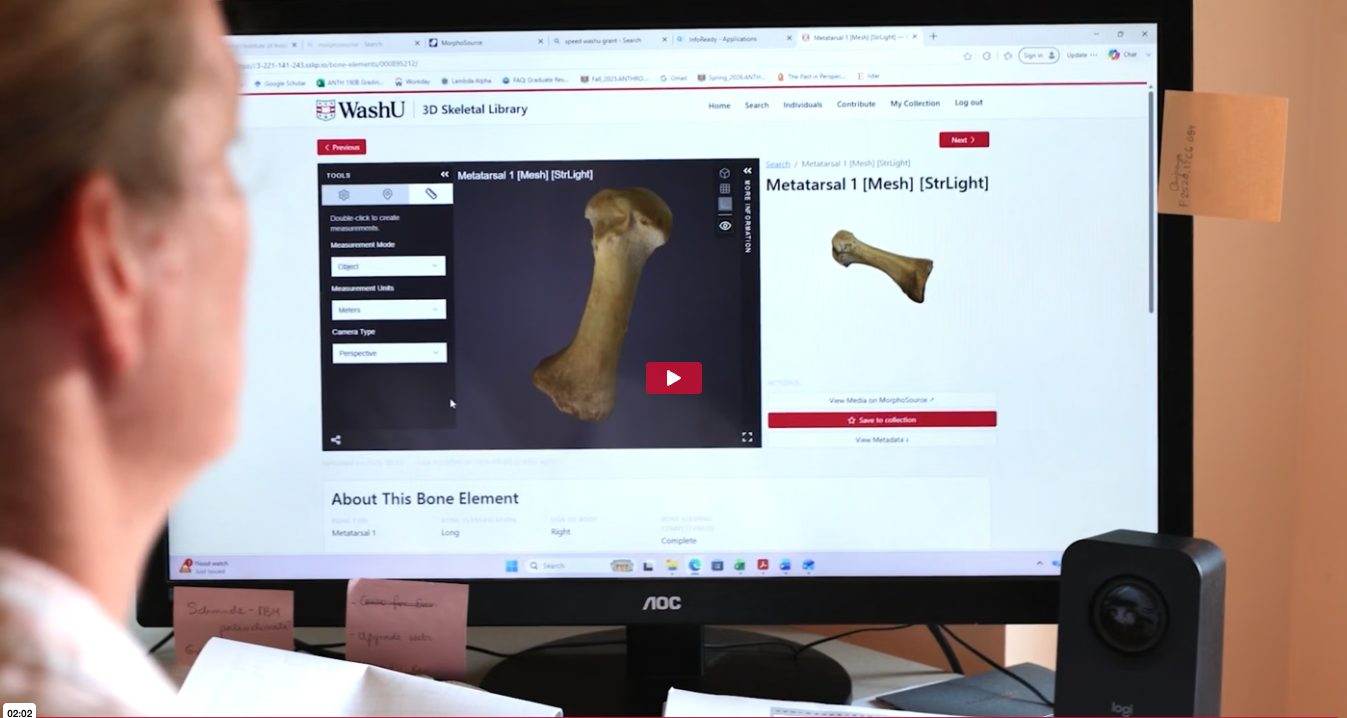
Baitzel remarks, “We are looking at a future where teaching and research will probably move into a digital age. So, my colleague Dr. Cody Prang and I played around with the idea of what that would look like.” The resulting concept was a collaborative digital portal where researchers around the world can archive, search, and share 3D skeletal scans. Looking ahead, the team is also integrating advanced analytical tools into the pilot. “We are thinking through machine learning as the next step in how we can transform osteology-related research in the twenty-first century,” Baitzel explains. The final deliverable from the summer cohort is a portal designed to explore, analyze, and share ethically sourced human remains. To populate the library, WashU researchers created 3D scans from human remains housed at Texas State University’s Forensic Anthropology Center. Each model represents an individual who explicitly consented and generously donated their body for scientific research.
Technical and Ethical Innovation
The technical strategy began with WashU Libraries presenting a curated selection of 3D data repository options to the cohort. In my position as the Data Management & Sharing Specialist at the Libraries, I served as the technical lead, presenting an initial framework and tentative project plan. I provided direct one-on-one development mentorship to the students throughout the summer, guiding their technical architecture and supporting nuanced conversations around data ethics and sharing.
The student developers and designers independently evaluated the 3D data platforms and constructed their own project plan. To support their execution, Libraries 3D Visualization Specialist Harper Tooch provided comprehensive 3D data training to the cohort and provided specialized 3D data consultation throughout the summer.
Undergraduate student developer Ayla Burba took the lead on designing the user experience and portal architecture, collaborating closely with graduate designer Tejas (Udit) Garg (Master of Design for Human-Computer Interaction). Starting with options presented by the technical lead and 3D data advisor, the students researched and evaluated multiple 3D data platforms before selecting MorphoSource for the backend. To expand its functionality, Burba and Garg collaborated with the principal investigators to create custom, searchable metadata fields unavailable in MorphoSource. The new fields were tailored specifically to the learning and research needs of biological anthropology, forensic biology, and biomedical research.
Simultaneously, student developer Natalia Jamula spearheaded the project’s machine learning and automation framework. Jamula designed and coded Python scripts from scratch to automatically extract morphometric measurements from 3D scans, integrating the pipeline directly into the portal. Mastering human anatomy on the fly was her biggest hurdle: “I read through textbooks to learn how to take bone measurements manually, but I was completely unfamiliar with these anatomical landmarks,” Jamula laughs. “It’s just not part of the data science curriculum.
Student Growth and Collaborative Impact
All the students had to learn a great deal about human anatomy, the history of anthropology, and evolving ethical frameworks before building a technical solution for such a complex issue. Baitzel reflected on the team’s discussions, “What type of data should be shared in this kind of portal? What mechanisms can we include to perhaps obscure or restrict access to different lines of information?”
The students also pushed to consult with external partners on ethics, including the Forensic Anthropology Center at Texas State University. The team was happily surprised by the overwhelmingly positive reception the project received from external researchers. For Burba, the cross-disciplinary exposure was invaluable. “I feel like it was really enlightening getting to see the expertise that all of these people have in their specific fields,” she shares. “As someone who knew nothing about anthropology, getting to hear about the deep problems and history of the field, as well as the work being done to bring it forward into the future, has been a wonderful experience.”
Faculty leadership was equally impressed by the student contributions. “Not only have I been absolutely impressed with the students’ abilities in terms of web development and coding, which are completely beyond my expertise, but really with the thoughtfulness and intellectual investment that has come from the team,” Baitzel says.
The Future of Ethical Open Data
The 3D skeletal library has implications reaching far beyond anthropology. The project’s website and AI tools facilitate data sharing among a global community of researchers interested in human variation through time and space, including human evolution and ancestry studies, health and illness in past and present populations, and victim identification in forensic contexts. However, ushering in this future requires broader adoption. The platform’s long-term success will depend on cultivating a global community committed to ethical open data sharing.
To learn more about the project, please visit the student-created project page.
Video by Carter Staley, Digital Marketing and Communications Manager, DI2 Accelerator.
This project was made possible through the support of the DI2 Accelerator and WashU Libraries.
- Name
- Avianna Wooten
- Job Title
- Data Management & Sharing Specialist