

Staff Pick: Native Tongue
For no reason, lately I’m drawn to reading dystopic visions of America’s future. My sensibilities lean more toward The Handmaid’s Tale than The Last of Us, so I’ve been intentionally seeking particularly feminist hells. In addition to Margaret Atwood, I’ve been exploring science/speculative fiction authors Sheri S. Tepper (Gibbon’s Decline & Fall; The Gate to Women’s Country), Marge Piercy (Woman on the Edge of Time), and, most recently, Suzette Haden Elgin.
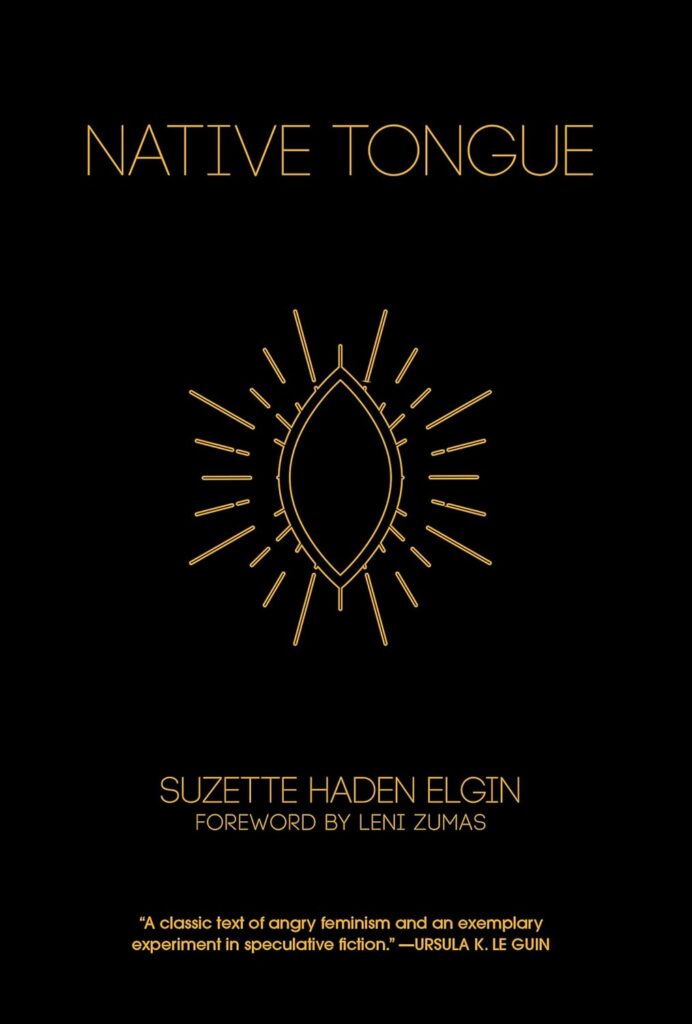
I just finished the first book in Elgin’s eponymous Native Tongue trilogy. Native Tongue is set in an alternate timeline: in 1991, the 19th Amendment has been repealed, and women are legally considered sophisticated children. Unrelatedly, humans have made contact with intergalactic species for trade, and a low class of people known as “Linguists” bears all responsibility for maintaining communication through translation. The plot revolves around the women Linguists’ efforts to create a secret female-exclusive language, Láadan, as an act of resistance.
Elgin, also a researcher of experimental language construction, invented Láadan to go along with her trilogy. Láadan was Elgin’s attempt to test the Sapir–Whorf hypothesis, or linguistic relativity, which posits that the language we use shapes what can even be conceived. It is a very popular subject in science fiction (1984’s Newspeak being a famous example) and academic fields, including feminism. Around this same period, philosopher Mary Daly (Gyn/Ecology) produced a tongue-in-cheek parody dictionary, Websters’ First New Intergalactic Wickedary of the English Language (1987), which, while silly, speaks to the attempts of feminists to reframe language and exert control over the political conversation.
Like all dystopian novels, Native Tongue is more about the concerns of the day than prophecy for the future. Some strands have aged better than others (LSD experiments on babies?), but reading Elgin in the context of her peers, while not exactly comforting, highlights a history of women resisting and theorizing relevant today.
It can be read as a standalone, but the conclusion does seem abrupt in isolation. WashU Libraries have the entire reissued trilogy (Native Tongue, The Judas Rose, and Earthsong) with new forewords and afterwords.
- Name
- Lydia Creech
- Job Title
- Curator of Film & Media