
Exploring Mosques in Morocco
This summer, through the support of the Newman Exploration Travel Fund (NEXT) award, I had the opportunity to explore a question that has lingered with me through the years: Why did the first mosque built by African American Muslims in Phoenix, Arizona, draw so profoundly from the architectural language of Morocco? In the early 1980s, a small community of African American Muslims in South Phoenix came together to build the first masjid in the state. Yet what made this religious space distinct was its purpose and design. Unlike many American mosques that reflect more of an Ottoman or Indo-Persian influence, the founders of my childhood Mosque intentionally adopted Maghrebi forms—earth-toned walls, geometric zellij tilework, and a square minaret reminiscent of a North African Mosque’s silhouette. I grew up within those walls. Elders who had served in North Africa during their military years would tell me, “You’d have to see it to understand.” Those words have stayed with me. Decades later, I traveled to Morocco to do just that—to walk the streets and courtyards that had once inspired the architecture of a vital childhood anchor and to seek a deeper understanding of the spiritual and cultural bridges my elders saw.
Arrival and First Impressions
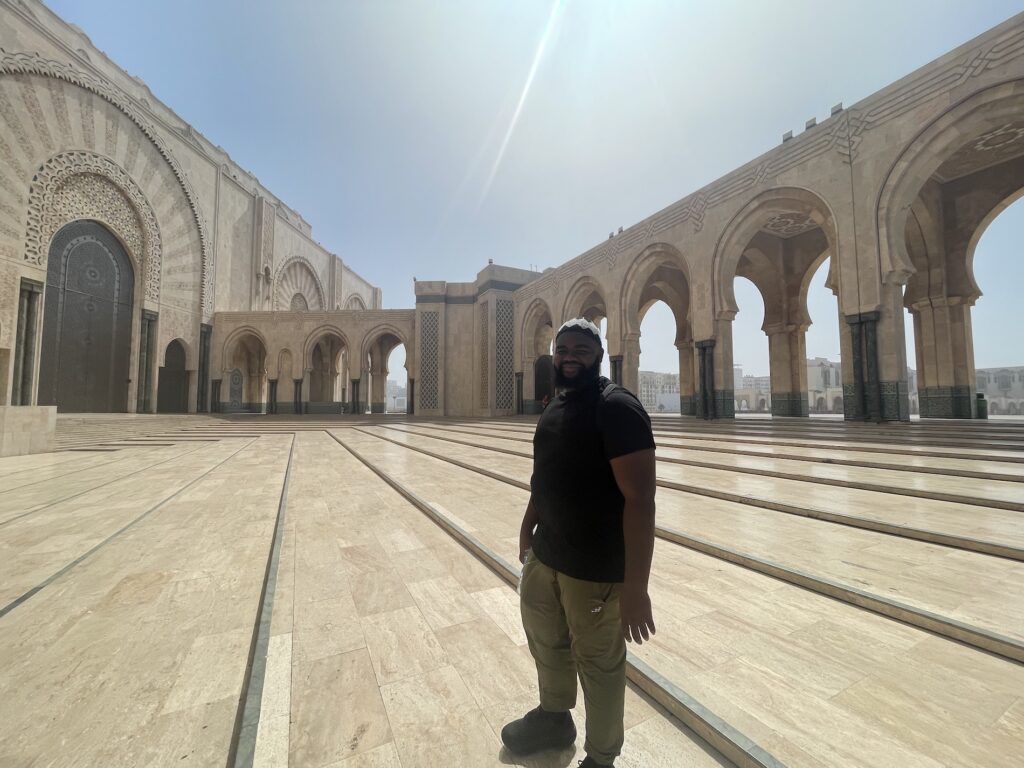
My journey began in Casablanca, although I only stayed briefly before heading to Rabat, where I had arranged to study at a local Arabic institute. I wanted to refresh my language skills to improve my ability to connect with people throughout the trip. At the airport, my taxi driver—friendly and talkative—decided to start my Arabic lessons right away. He spoke to me only in Arabic for nearly two hours, switching between modern standard Arabic and the local dialect, Darija. I probably understood about twenty percent of what he said, but his patience and enthusiasm made the ride both challenging and enjoyable. It was a fitting start to my journey, which focused on communication and cultural understanding. Stepping outside, I was immediately struck by how familiar the weather felt. Having grown up in Phoenix and spent summers visiting the beaches of California, the dry heat and coastal breeze gave me a surprising sense of comfort. During the drive from Casablanca to Rabat, I kept my eyes on the landscape—the soft evening light, the movement of people along the roadside, and especially the skyline dotted with mosques. The square minarets stood out most—green, white, or simple brick. In Phoenix, the minaret of my childhood Mosque had always seemed unique and out of place. Here, it was the norm. Seeing that architectural form everywhere confirmed that I had arrived in the place whose design had long shaped my sense of home.
Walking through Space and Time
Rabat
My time in Rabat was an essential beginning to my learning experience in Morocco. I spent several weeks studying at a small language institute near the medina, and each day outside the classroom became its own complementary lesson. I realized that even the simplest attempt to speak in another person’s language opens a door. Some of my most meaningful exchanges happened in the front seat of a taxi—drivers who turned into teachers, correcting my phrases with patience and good humor. Through these conversations, I was reminded that language is not only a tool of communication but also an act of hospitality—and often, of good fun.
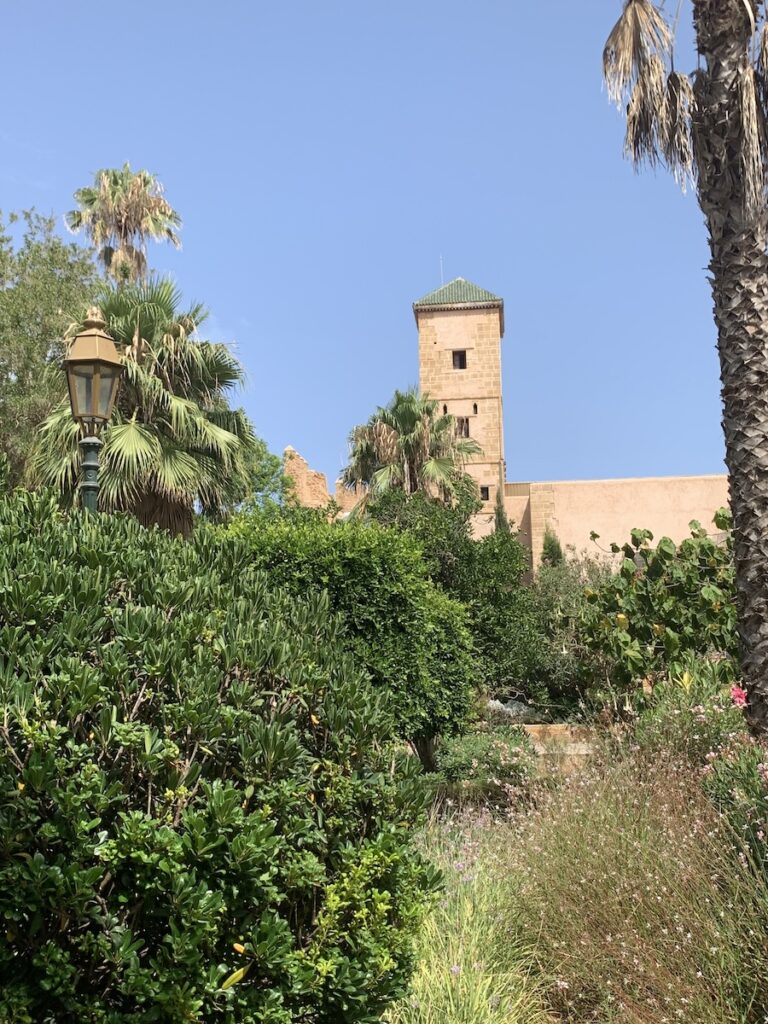
Beyond the classes, Rabat felt like an architectural conversation between past and present. Now Morocco’s capital and the seat of the royal palace, Rabat has long been a city of transitions—between dynasties, empires, and cultures. The Kasbah des Oudayas, which I visited on several occasions, was founded in the tenth century and still bustles with life through its vibrant markets, small cafés, and seaside terraces where people gather. Inside its old walls stands a mosque whose square minaret and simple geometric carvings carry the visual rhythm of early Maghrebi design. I learned that Rabat was once a refuge for Andalusian Muslims expelled from Spain—communities who remade home on a new shore. Their story reminded me of the elders I grew up with, who spoke about the Great Migration in the United States—families moving from the American South to the West and Midwest in search of new beginnings. Both groups were seeking the same thing: a place to belong and build a life rooted in faith.
A few miles away stands the Hassan Tower, its minaret rising from an unfinished dream. Begun in the twelfth century by the Almohad dynasty, the mosque was intended to be the largest in the world but was never completed after the sultan’s death. It reminded me of home, where our own mosque’s roof was once a constant challenge during the monsoon season. An elder—now passed (affectionally known as Imam Hassan)—told me that the original design had never been fully completed because the courtyard’s construction had exhausted the community’s funds. Yet, like the Hassan Tower, unfinished work can hold deep meaning. Both stand as testaments to persistence, faith, and the beauty of what endures, even when completion was never guaranteed.
Marrakesh
I also had the opportunity to visit Marrakesh, which later emerged as one of Morocco’s most important capitals after Fez. Founded in the eleventh century by the Almoravid dynasty, the city introduced architectural ideas that would define much of the Maghreb—using earthen walls and courtyards designed for shade and reflection. The Almoravids were known as reformers who valued both scholarship and simplicity, and Marrakesh reflected that duality.
For the days I was in Marrakesh, I visited Jemaa el-Fnaa, the city’s historic square. Today, as in centuries past, it remains a gathering place of trade, performance, and exchange. Day and night, vendors sell, and an open-air kitchen is filled with the scent of cumin, smoke, and the exquisite Moroccan mint tea! It was easy to imagine how this space once functioned as a market and a major civic center.
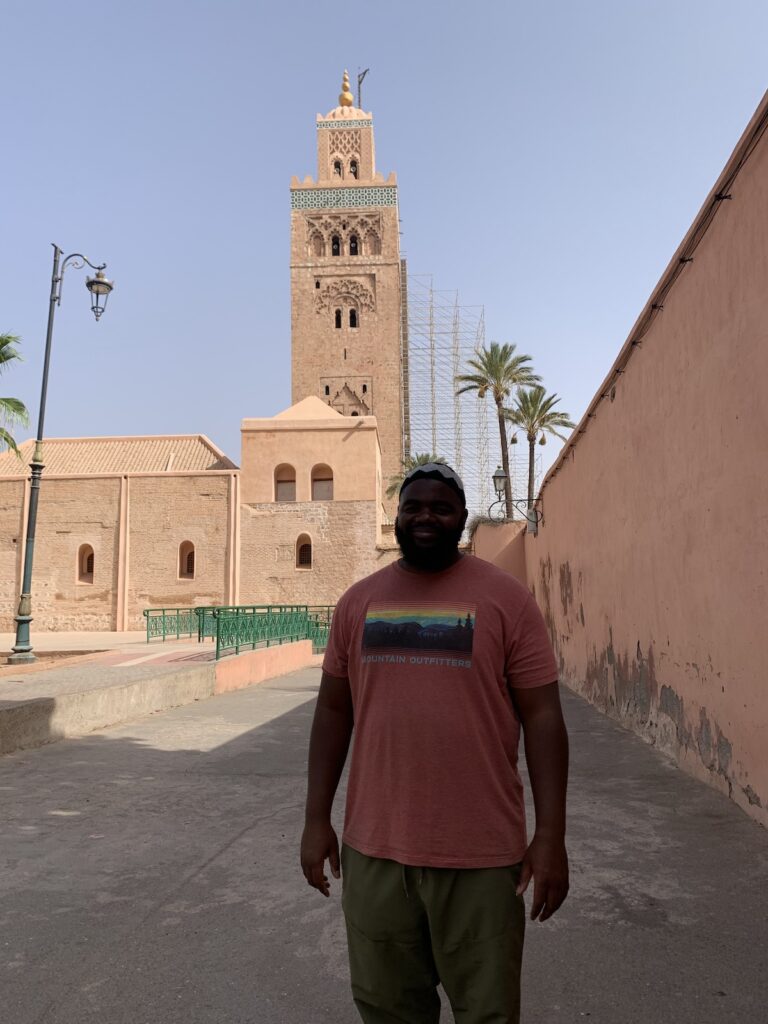
Not far from the square’s center, I also visited the Koutoubia Mosque, built in the twelfth century by the Almohad dynasty under Caliph Abd al-Mu’min, after his conquest of Marrakesh in 1147. The Almohads demolished the earlier Almoravid mosque on the same site and erected Koutoubia to declare their new paradigm. Its name, al-Kutubiyyin, meaning “of the booksellers,” recalls the manuscripts once copied and traded in stalls around its walls, where knowledge was treated as an act of faith. The mosque’s forty-five-meter minaret is adorned with stone tracery and with four copper spheres, which later became the prototype for Morocco’s most famous towers, including Rabat’s Hassan Tower, which I had seen during my stay in Rabat, and Seville’s Giralda. One afternoon, I even had the opportunity to walk through an ancient olive grove that was said to have been cultivated for more than eight hundred years, its roots tracing back to the same era as the Koutoubia itself. Marrakesh felt like a living testament to endurance—where faith, labor, and community intertwine, quietly shaping the rhythm of daily life.
Fez—Scholarship and Sanctuary
Of all the cities I visited, Fez was the one that stayed with me the longest. Founded in the 8th century by the revered Idrisid ruler Moulay Idriss, Fez remains Morocco’s spiritual and intellectual heritage site. In this place, time also seems to fold in on itself. The train ride from Rabat was serene, about three hours through hills and open fields. Sharing a cabin with several other travelers, I was reminded again of the Moroccan warmth I had encountered since my arrival: the eagerness to share and learn about one another, and the unspoken generosity that bridges even language barriers.
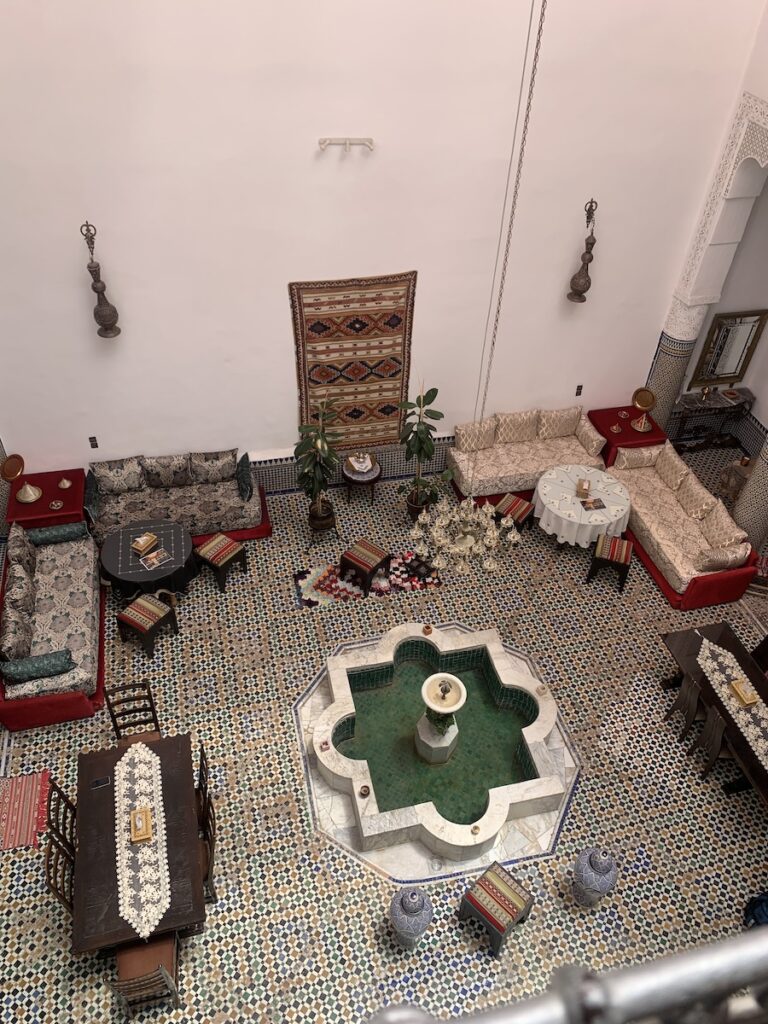
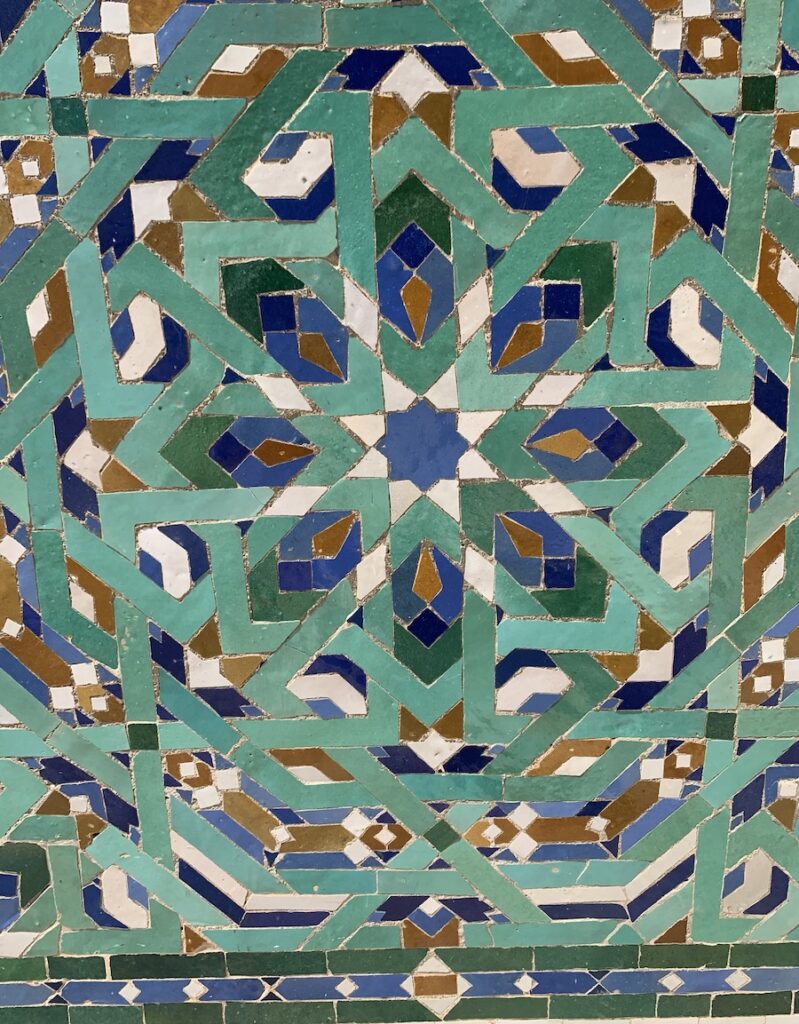
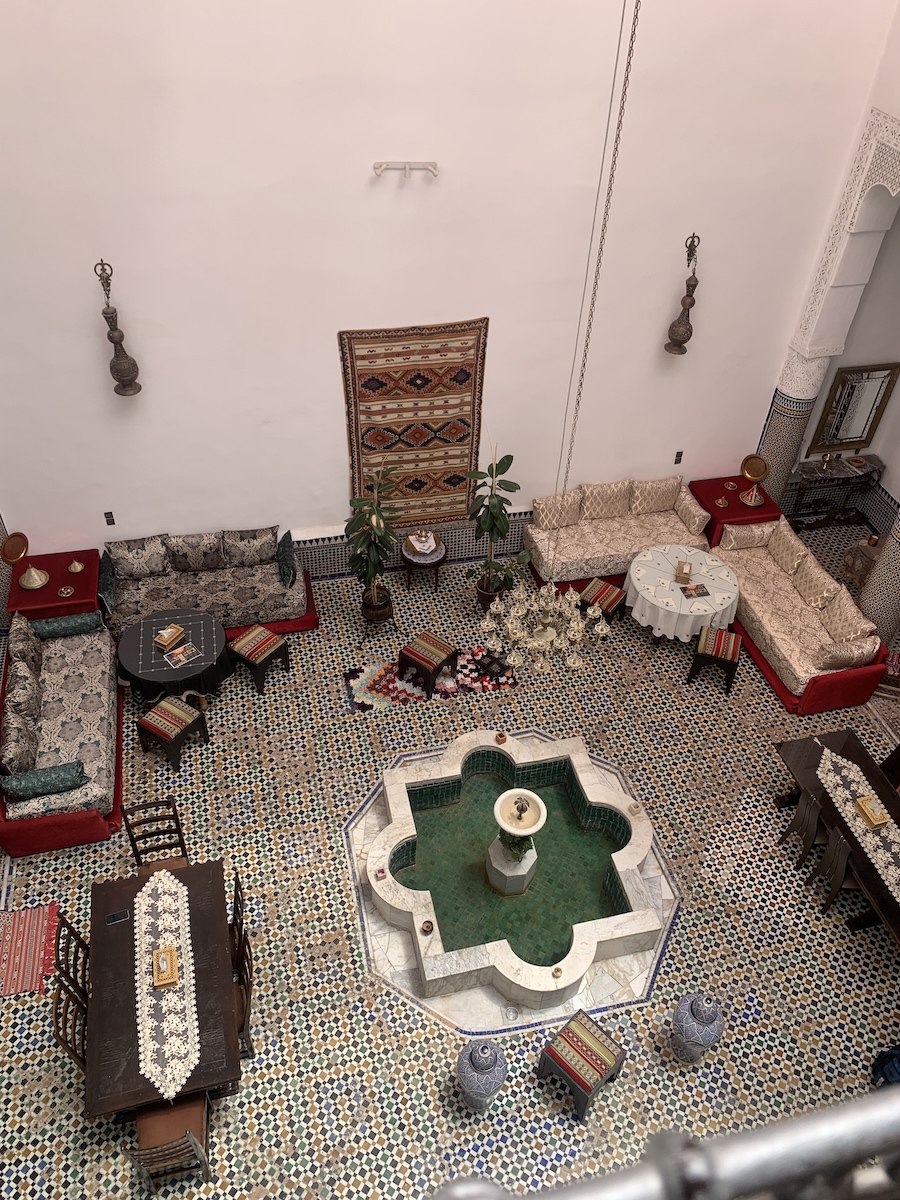
While in Fez, I stayed in a traditional riad within the medina, a home in one family for over two centuries. From the outside, its walls were plain and unassuming. But stepping through the doorway revealed an interior of beauty—an open courtyard centered around a fountain, surrounded by hand-carved plaster, zellij tilework, and cedarwood ceilings. Like the minaret of a Maghrebi mosque, the riad’s also reflect a more profound meaning: what matters most is what lies within. That moral and aesthetic principle—humility on the outside, beauty and sincerity within—felt like a well-known Islamic ethos that Muslims hear often in Friday sermons. It was the same ethos I recognized in masjid back home, where the plain exterior gives way to an inner courtyard alive with the beauty of its people, and artistic mosaics, a fountain, and garden landscape.
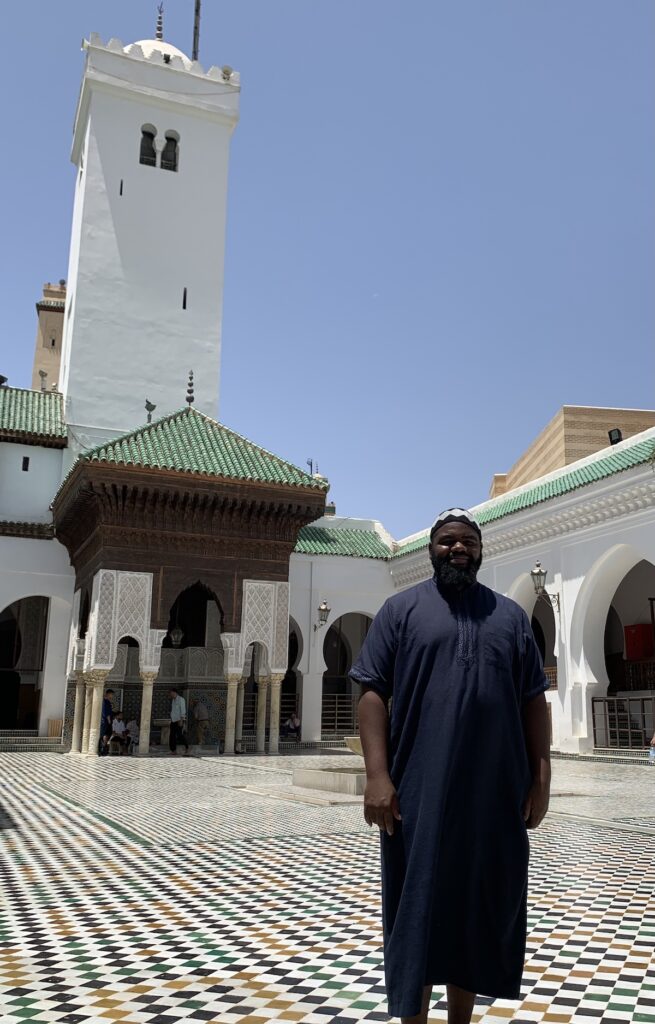
Over the following days, I explored Fez’s labyrinthine medina with the help of a local guide, who warned me that even lifelong residents can lose their way among its 9,000 narrow streets. With my guide, I visited the University of al-Qarawiyyin, founded in 859 CE by a woman named Fatimah al-Fihri, and widely recognized as the world’s oldest continuously operating University. Originally established as a center for Qur’anic literacy, it grew into a hub of science, philosophy, and medicine that helped shape the intellectual life of the medieval world. Thinkers like Ibn Khaldun, whose Muqaddimah laid the foundations for sociology, once studied or taught in this city.
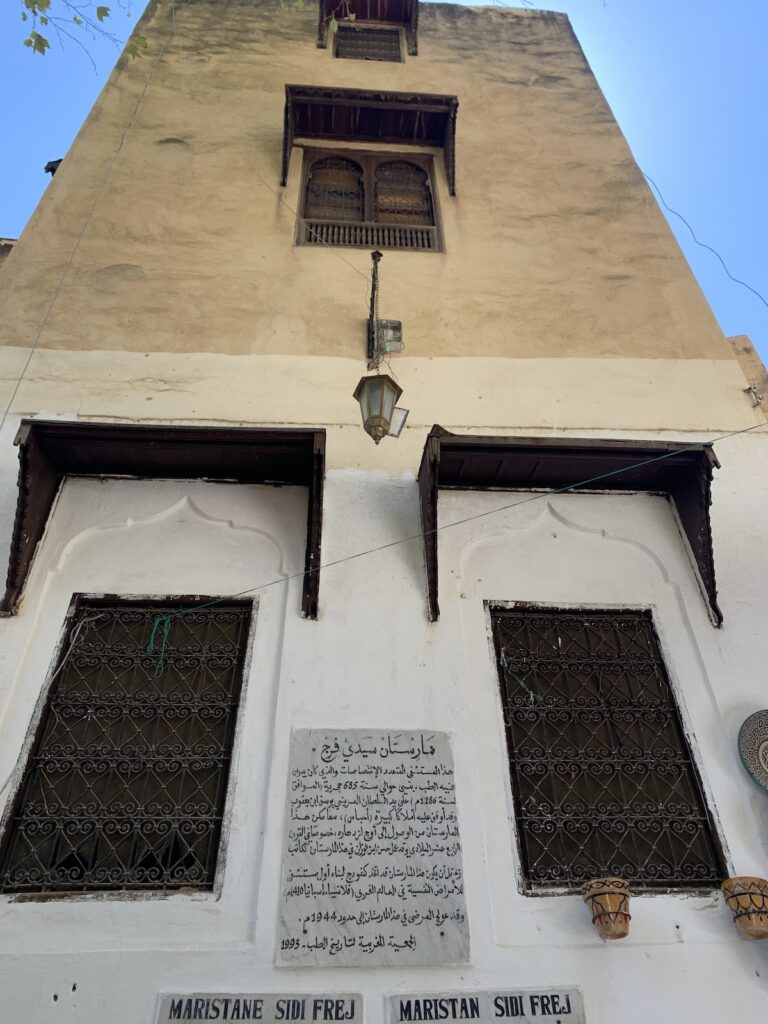
Another site that surprised me deeply was the Maristan Sidi Frej, one of the world’s earliest psychiatric hospitals. Built in the thirteenth century, it treated mental illness not with punishment but with care, music, and water therapy. As a social worker and scholar of mental health, I felt inspired by Morocco’s early recognition of human dignity, yet saddened that such histories remain largely unknown in the West. It reminded me that Africa has long been a wellspring of intellectual and medical innovation, even when those stories have been marginalized or forgotten.
Yet what I felt gives Fez its truest beauty—perhaps less known than its significant contributions to science and knowledge—is its people, whose character reflects the city’s many accomplishments. Fez is a city of reverence and reflection, where architecture mirrors the devotion woven into daily life. Travelers come from as far south as Nigeria and east as Syria to pay homage to a city that has produced generations of respected scholars and devoted worshippers who once walked its streets. In courtyards, shops, and mosques, it is common to find locals and travelers gathered together in remembrance, seeking to purify their hearts and bring their souls and bodies into harmony. Being there again, I could not help but think of the elders back home from my childhood—those who modeled much of this aim: a constant effort to refine oneself, to live with intention, and to be of benefit not only for one’s own salvation but as a good and generous presence in the world.
Return and Reflection
So why Maghrebi? Why did the founders—my elders—choose this place to represent their faith space? The answer is not simple, but Morocco’s history, past, and ethos offered the necessary clues. In traveling, I learned that Morocco has long been—and continues to be—a place of integration, negotiation, and self-definition. Its layered past leaves its best interpreters not in monuments, but in its people: people who hold the freedom to define themselves and to make meaning of a history shaped by diversity and resilience. That struggle, that creative act of identity, reminded me deeply of what African American Muslims in south Phoenix were also tasked to do—to build a sense of belonging out of different pieces, to root themselves in faith while shaping a home that reflected who they were. Perhaps the founders’ choice also spoke to something more: a desire to remember. Just as the intellectual legacy of Fez has too often been forgotten, they built a mosque that would quietly insist on memory—that our stories, our connections to the African continent, no matter how distant, still mattered. Their decision to draw from Maghrebi design was aesthetic and philosophical. It was a declaration that beauty is not defined by those who overlook you, but by the integrity and light you carry within. But perhaps my elders were right all along: you really have to go to understand.
- Name
- Husain Lateef
- Job Title
- Associate Professor at the Brown School