
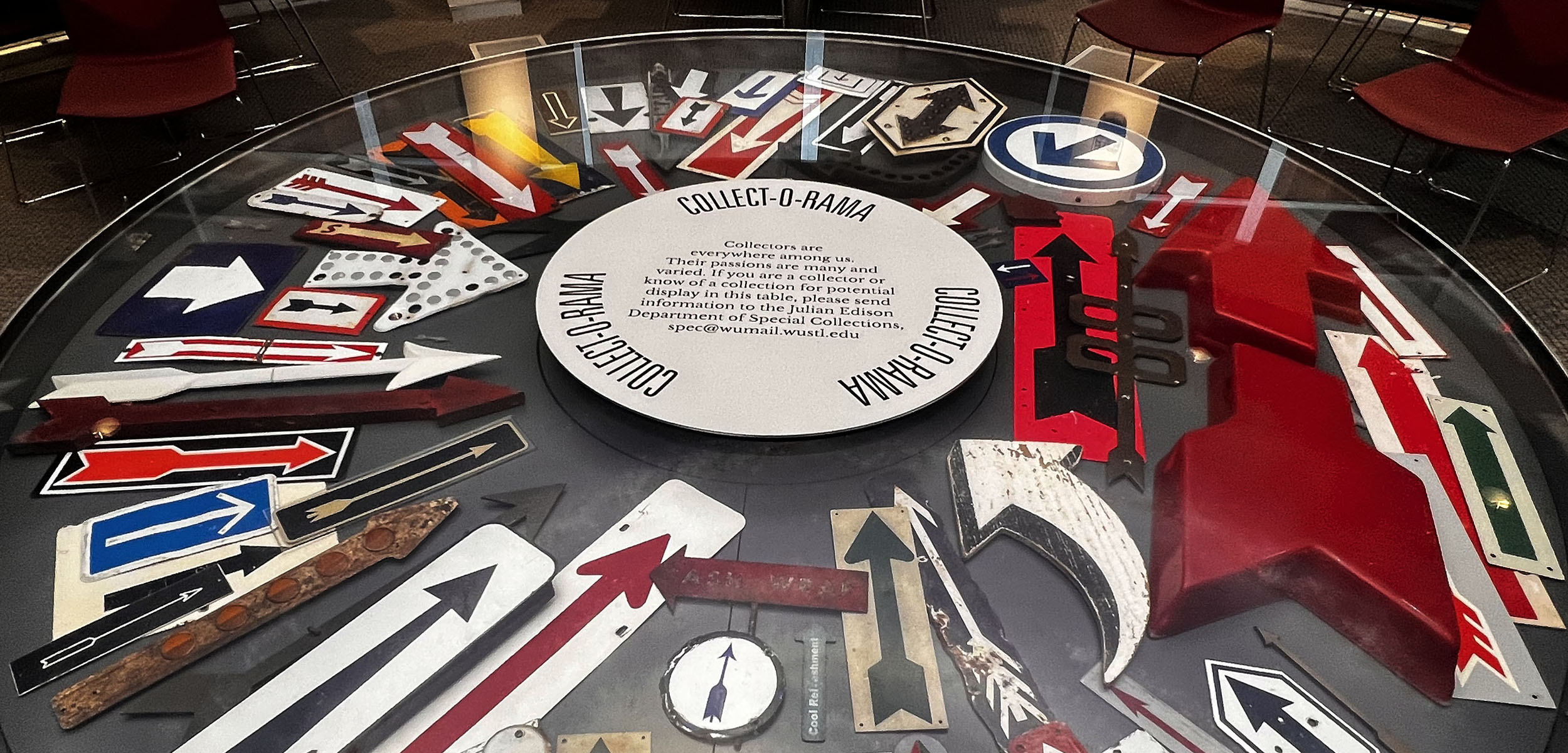
Me and My Arrow(s)
Jeremy Kannapell’s collection of arrows has been ongoing for nearly 15 years. Kannapell cannot say exactly how or why it began, except for some odd aesthetic appreciation for the simplicity, minimalism, and directness of the arrow sign. As they accumulated, Kannapell realized that they made poetic sense when juxtaposed to one another, like disregarded artifacts of human movement.
At this point, Kannapell believes he has collected over 200 arrow signs of various sizes, from different decades and materials. These arrows range from porcelain and metal ones manufactured for early 20th-century industrial workspaces, to enamel ones for gas stations and bygone transportation centers, handmade ones, and cheap plastic ones made for strip malls and supermarkets of the 1980s. Some were too big to fit into this display.
On a practical level, arrow signs are immediate – representing direction, movement, and pursuit. Apparently, even NASA thought about this when designing the golden plaques on Pioneer 10 and 11 (which have an arrow showing the trajectory). They made the assumption that other intelligent life likely had an understanding of arrows as directional and would understand an arrow pointing to something.
In Kannapell’s own words:
I usually travel by road in my line of work, and despite the convenience of smartphones and GPS, I still often find myself completely lost, wandering without any sense of direction whatsoever – and my eyes inevitably search for something (anything!) resembling text and an arrow. While the lyrics to Harry Nillson’s “Me and My Arrow” likely refer to archery arrows (rather than arrow signs), they always linger in the back of my mind: Me and my arrow / Straighter than narrow / Wherever we go, everyone knows / It’s me and my arrow.
Jeremy Kannapell for the Me and My Arrow(s) exhibition