
Q&A with Author of Thy Will Be Done: George Washington’s Legacy of Slavery
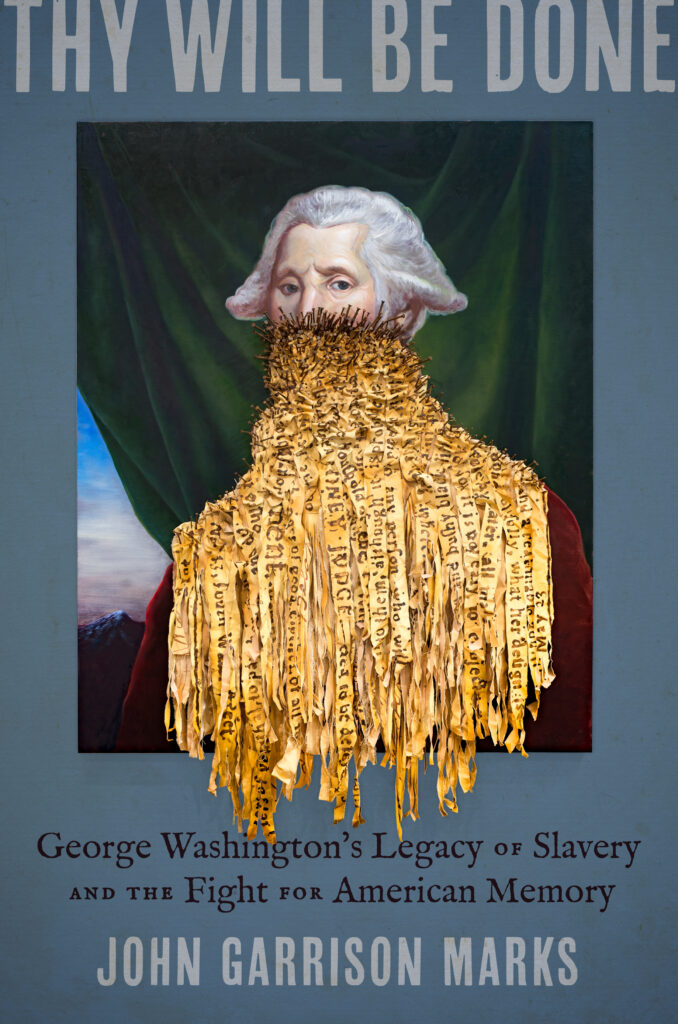
In the following interview, John Garrison Marks, historian and author of Thy Will Be Done: George Washington’s Legacy of Slavery and the Fight for American Memory (2026), explores the relationship between George Washington and slavery and how America has grappled with Washington’s legacy for more than 200 years.
WashU Libraries and WashU Studying Slavery invite you to a special event on November 5 to commemorate the 250th anniversary of the Declaration of Independence. John Garrison Marks will discuss his book and attendees can view two printed original Declarations of Independence and a showcase of rare materials related to the founding of America. Learn more and sign up for the event.
What inspired and motivated you to write Thy Will Be Done?
Marks: My inspiration came from a few places. Initially, I was interested in telling the story of what happened to the people Washington freed from slavery after their emancipation. Their stories were always at the end of a book about Washington, but I wanted to move them to the beginning of a book about free Black Virginians. That ended up becoming just one chapter of the book because while researching, I encountered an overwhelming amount of evidence that people were regularly discussing Washington’s involvement in slavery long after his death—and doing it in ways that seemed incredibly similar to the controversies of the past several years.
Part of the reason I went down that road at all was the demonstrations for racial justice during the summer of 2020, which so often came to focus on Washington as a symbol of the deep roots of racial oppression in America. At the same time, I was also working to help museums prepare for the 250th anniversary in 2026, so I sensed there would be a rare opportunity in 2026 to have a much broader conversation about Washington and slavery. In the end, the book has become relevant in ways I never could have imagined.
What are some of the tensions and contradictions around George Washington and his ties with slavery that your book explores?
Marks: Washington was actively engaged in enslaving other human beings for the entirety of his adult life. He bought and sold people as property and exploited their labor to built his wealth. At the same time, however, Washington regularly wrote about his desire to see slavery in America come to an end. More importantly, in his last will and testament, Washington freed from slavery the 123 people he owned. This tension between Washington the enslaver and Washington the emancipator has troubled Americans for more than two centuries, especially because Americans so often use Washington as a symbol for the nation itself.
What are the dominant ways in which Washington has been remembered over the last two centuries? Is there a larger vision of American identity that underpins the different narratives of Washington and slavery?
Marks: Washington’s involvement in slavery has been part of public discourse among every generation of Americans from our very earliest days as a nation. While the controversies surrounding Washington and slavery over the past several years have felt new, nothing could be further from the truth. At every turn throughout our history, there have been Americans insisting that we acknowledge or reckon with Washington’s involvement with slavery, claiming Washington’s history with the institution holds lessons for the present day. Sometimes this is presented as praise, sometimes as searing criticism, but there have always been Americans driving the conversation about Washington’s legacy of slavery.
Take the fight over slavery during the lead-up to the Civil War, for example. Some abolitionists praised Washington’s decision to free the people he enslaved, arguing that if Washington saw fit to free his slaves, what could be more American than ending slavery? Other abolitionists, however, used withering indictments of Washington’s ties to slavery to declare him a hypocrite, and make clear that the roots of racial oppression in America go back to the very beginning. Proslavery southerners, meanwhile, also invoked Washington’s slave owning as evidence of the fundamentally American nature of slavery and to justify their willingness to secede to defend it.
My book explores these kinds of stories, revealing how different groups and different times have shaped and wielded Washington’s complex history with slavery to fight the cultural and political battles of the present.
Based on your book, how do you think we should understand the complex legacy of Washington 250 years after the adoption of the Declaration of Independence?
Marks: One thing that has become clear in researching, writing, and talking about this book is that there will never be a single correct answer to this question. There’s no long-hidden document, no masterwork of history that can possibly tell us precisely and correctly what we should make of Washington’s involvement in slavery. We’ve been arguing over whether Washington was a hero or a villain for nearly 250 years because his views were so utterly contradcitory, so irreconcilable. What I hope my book helps people do is to have a slightly different—and to me, more interesting—conversation about why we care so much about Washington and what he should mean to us now.
Enslaving hundreds of human beings across five decades is beyond reprehensible—it’s monstrous. I certainly understand those who feel like nothing else—not even Washington’s eventual emancipation of those people—could ever balance that out. But I’ve also seen how so many people throughout American history, including Black leaders and descendants of slavery at Mount Vernon, have a different perspective on that question, so I’ve come to appreciate how others can each different, equally justifiable, conclusions.
There’s no one right answer here; there’s only the conversation we have to try to find one.
Can you tell us a bit about the process of writing your book? Did you visit archives and sift through primary sources to understand your subject?
Marks: Writing a book that spans nearly all of American history was a real challenge. I was fortunate to receive a year-long fellowship from the John W. Kluge Center of the Library of Congress to research the book—and yes, spending a year researching at the world’s largest library is as good as it sounds! I don’t think I could have conducted the research for this book anywhere else. Even though many of the sources I consulted have now been digitized—Washington’s correspondence, 19th and early-20th century newspapers, early Washington biographies and pamphlets, for example—the Library of Congress gave me access to all of them in one place. Being a Fellow at the Kluge Center also meant I was part of an intellectual community that helped me make sense of the work as I was doing it.
This book also featured research unlike any of my previous work. I visited historic sites, interviewed staff, and sat down with several people descended from ancestors who were enslaved at Mount Vernon. That more journalistic approach to storytelling helped me expand my sense of what counted as “research” and let me tell a more compelling, more accessible story. At several places throughout the book, I try to center my experience as a researcher and writer to help readers better understand what it means to grapple with these questions and to try to understand the past.