
James Merrill Centenary Postcards & Festival
In this second of a three-part series commemorating the centenary year of poet James Merrill, we are highlighting a handsome set of postcard booklets made in conjunction with our exhibit, James Merrill’s Poetic Places (which closes July 19), and which are available for free in Special Collections or by request.
We also want to help spread the news about the centenary festival happening in October in Stonington, Connecticut, hosted by our good friends at The James Merrill House (JMH). Click through to see the conference overview and to register. Read on to explore images from some of the postcards along with related content from the upcoming festival.
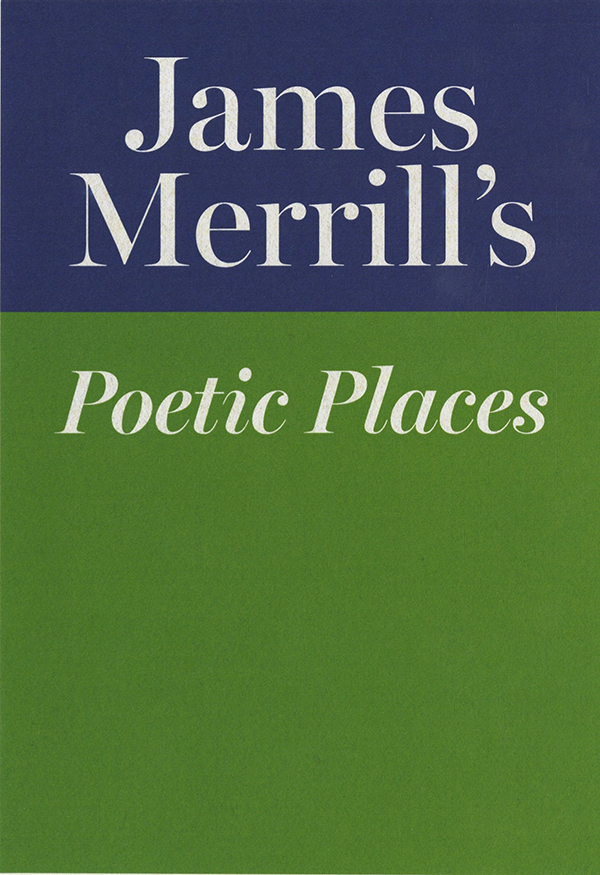
In our centenary exhibit at John M. Olin Library we focused on six important places to Merrill and his poetry. This gave us the idea of printing a set of postcards (one card for each place), like a booklet you might buy in a souvenir shop. Each card can be detached and mailed. The cover follows the design theme of the exhibit itself, which is based on Merrill’s 1962 book of poems, Water Street.
The title of that book is the street where Merrill’s longtime home in Stonington was located, which is where the James Merrill House has been since his death in 1995. The JMH has long had a writers-in-residence program. You can hear past fellows of the JMH reading the book in its entirety, in the Reading Of Water Street session led by Rob Schlegel at the centenary festival.
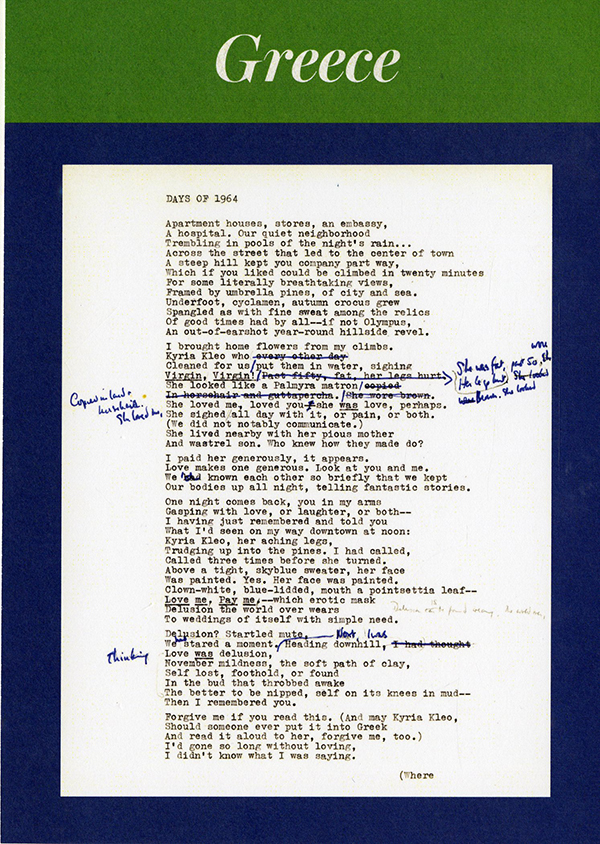
Each of the six cards has a different draft page of a poem on the face of the card. We wanted to present Merrill’s worksheets in a manner similar to natural scenes or buildings from a traditional postcard—artifacts of Merrill’s imaginative landscape or architecture, if you will, as it was being formed. One can visit and experience for oneself these worksheets and drafts in the James Merrill Papers.
The choice for the Greece postcard is “Days of 1964,” the closing poem of Merrill’s National Book Award-winning book from 1966, Nights and Days. In the poem he lovingly and archetypally portrays his neighborhood in Greece, his matronly cleaning woman, Kyria Kleo, and his new lover, Strato Mouflouzelis.
At the Merrill’s Poetry of Place session, Rachel Hadas and David Yezzi will be in conversation about Merrill’s poetry of place, with Rachel focusing on his poems set in Greece.
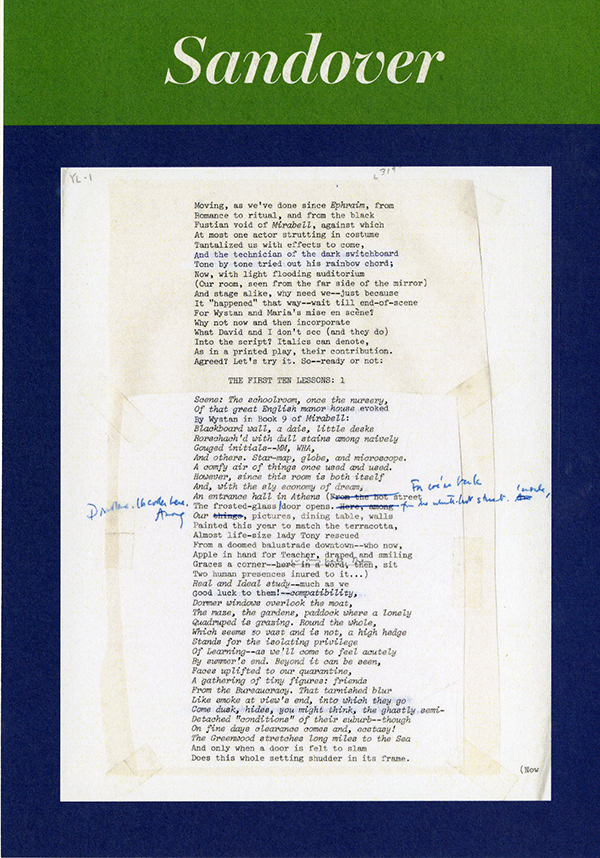
On this draft page from Scripts for the Pageant, the third book in the Ouija board trilogy, Merrill sets the scene in a classroom of an old English manor house that would be come to be called Sandover. This is where all the lessons of the spirit world would soon be revealed.
In Ghosts, Ouija & The Occult, Paul Merrill will discuss The Changing Light at Sandover and Merrill’s engagement with mysticism, spiritualism, and the occult.
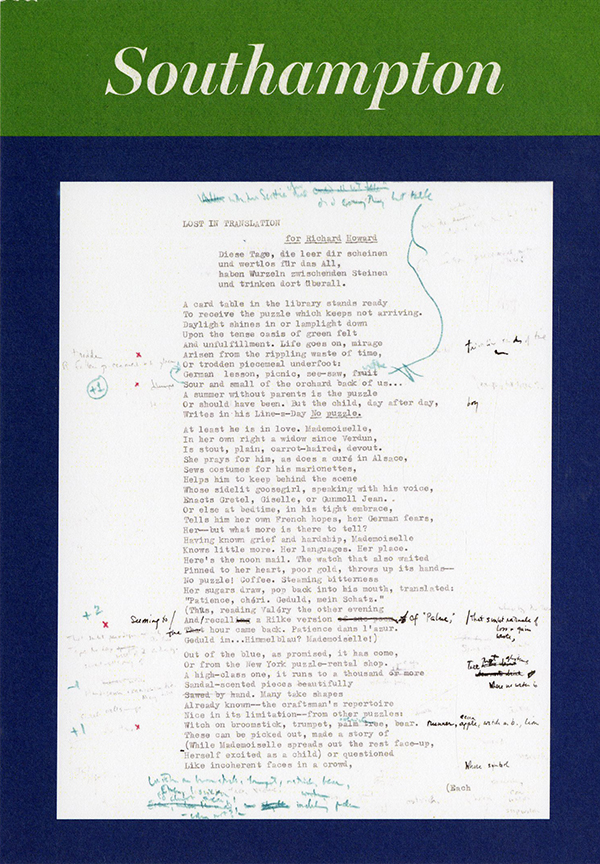
The first page of a “Lost in Translation” draft is on the face of the Southampton card. The jigsaw puzzle at the center of the poem is one of many objects from Merrill’s life that inspired him to piece together multi-faceted works of literary art. Puzzles in general always fascinated Merrill, especially those involving letters and words, and many of the poems he crafted could be considered puzzles themselves.
Two sessions, both including workshops, speak to these themes: Objects & Poems, with Timothy Donnelly; and Wordplay & Crosswords, with Adrienne Raphel, Christopher Spaide, and Natan Last.
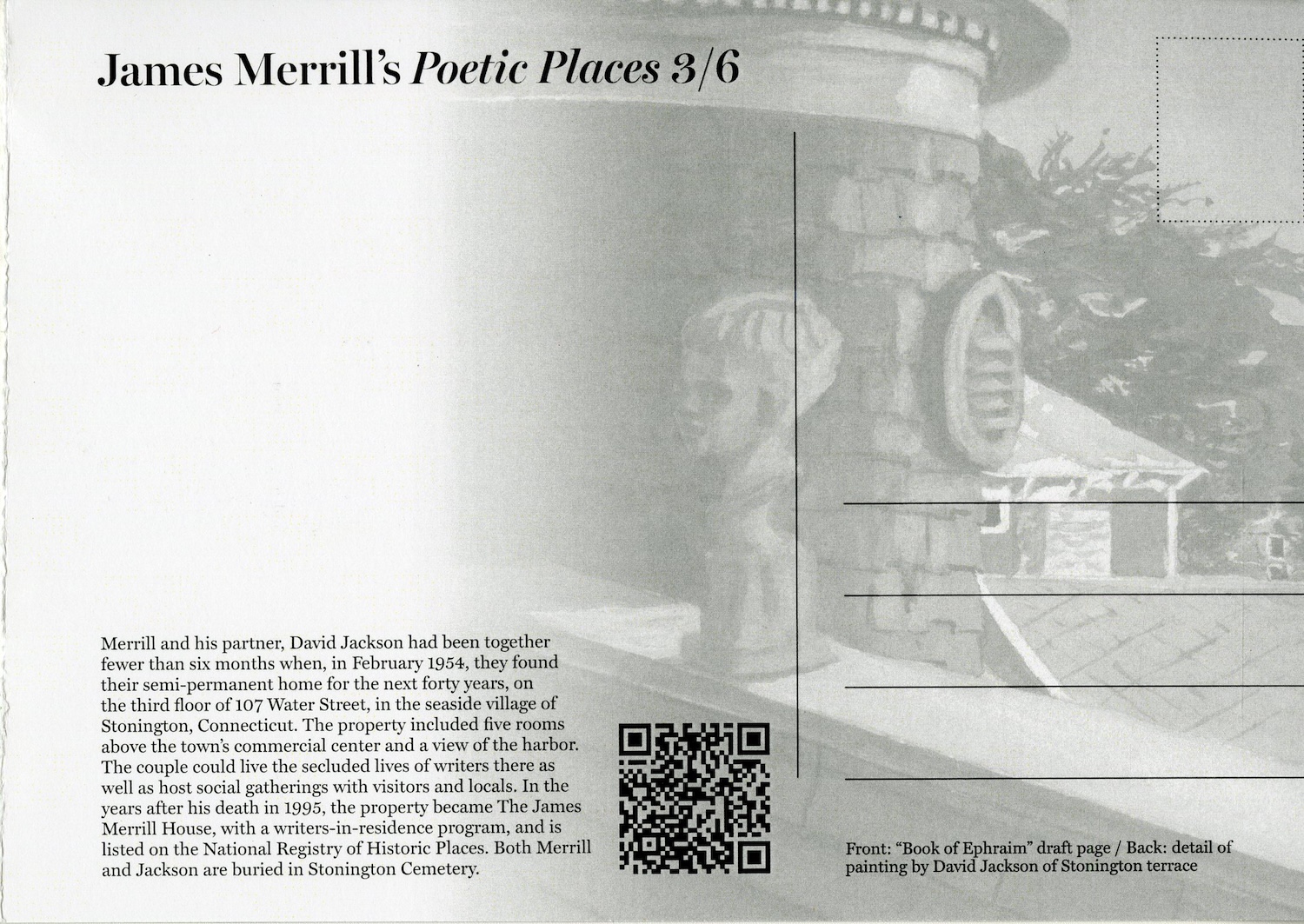
The back of each card features detail from an image of another selected item in the respective exhibit case. The back also includes an overview of that case and a QR code to access our various Merrill resources in WashU Libraries Special Collections.
The artwork of David Jackson, Merrill’s longtime partner and housemate in four of the places featured in the exhibit, is prevalent in the exhibit and included on two of the cards. On the Stonington card it is Jackson’s painting of a six-year-old Merrill bust on the terrace of their home at 107 Water Street (which Merrill also describes in his poem “Bronze”).
There will be a number of opportunities to explore Stonington and 107 Water Street during the festival, including Merrill in Stonington, in which Sibby Lynch and Willard Spiegelman will lead an exploration of Merrill’s life and writing in Stonington. There are also three tours available, throughout the weekend: James Merrill Apartment Tour, Stonington Village Literary Walking Tour, and The Stonington Cemetery, Poets Corner Tour.
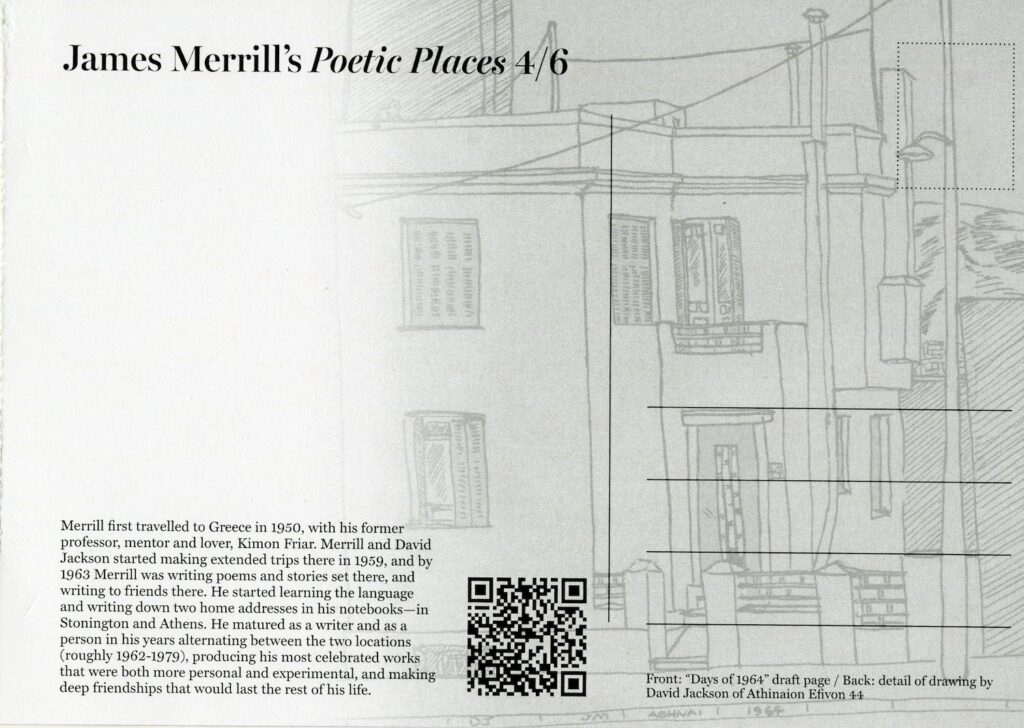
One of the houses featured in James Merrill’s Poetic Places is Merrill’s and David Jackson’s abode in Athens, Greece from 1964-1979, Athinaion Efivon 44, as depicted in this drawing by Jackson. Like their Water Street home, it was a nondescript, modest residence with small, private rooms in which the two men could spend solitary time writing and painting, or together at the Ouija board. Prints of the drawing were sent as a Christmas greeting card to friends, in 1964.
In The Apartment Aesthetic, Antoinette Brim-Bell and Walt Hunter will have a conversation on the symbolic and literal roles of houses in literature. This session and others will show how Merrill’s life and work fit into the larger literary world.
These are just a sampling of the exciting programming offered at the Stonington Literary Festival. For example, Henri Cole will be giving the keynote; Hilton Als will be reading from A Different Person; and Stephen Yenser and Langdon Hammer will be hosting two panels. Sessions are filling up fast, so we encourage you to register ASAP. Register at the James Merrill House & Writer-in-Residence Program website.
If do not live in the St. Louis area and you are interested in receiving a copy of the postcard booklets, please email [email protected]. Copies will also be available at the festival.
Also Read: James Merrill Centenary Exhibition

- Name
- Joel Minor
- Job Title
- Curator of Modern Lit Collection/Manuscripts