
Tennessee Williams Collection
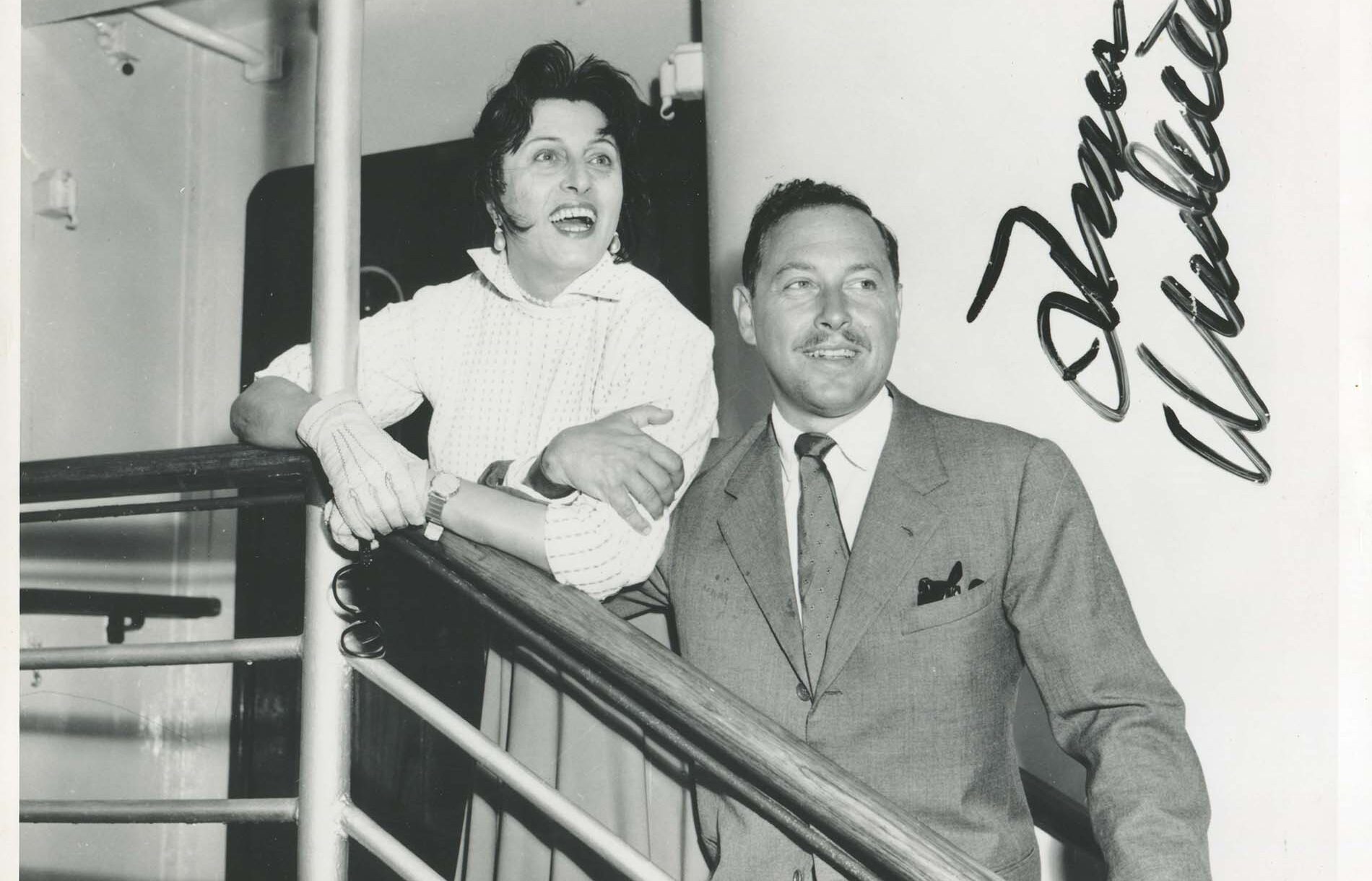
Thomas Lanier “Tennessee” Williams III (March 26, 1911 – February 25, 1983) was a renowned American playwright who also wrote short stories, novels, poetry, essays, screenplays, and a volume of memoirs. He received almost all the top theatrical awards for his dramatic works. In 1980, Williams was honored with the Presidential Medal of Freedom by President Jimmy Carter and is today acknowledged as one of the most accomplished playwrights in the history of English-speaking theater.
Williams came of age in St. Louis and began publishing poetry, fiction, and travel diaries in high school periodicals. He studied journalism and continued to publish work at the University of Missouri-Columbia, but dropped out in 1933 after three years and began an unhappy stint working at the International Shoe Company in downtown St. Louis, where his father was an executive.
The Mummers of St. Louis community theater group produced Williams’ earliest full-length plays around the same time he enrolled as a full-time student at WashU in 1936. In a playwrighting class at WashU, Williams submitted scenes from what would eventually become The Glass Menagerie. He published poetry in university literary journals and formed an unofficial poetry club with fellow WashU students William Jay Smith and Clark Mills McBurney.
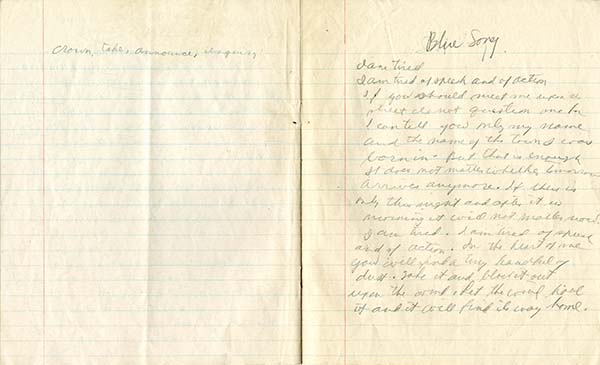
Discouraged by a student playwriting contest’s reception of his farcical one-act play, Me, Vashya, and having flunked his Ancient Greece class, Williams left WashU after one academic year. In 1938, Williams graduated with a Bachelor of Arts degree in English from the University of Iowa, where he wrote Spring Storm. Shortly after, he moved to New Orleans and became Tennessee Williams.
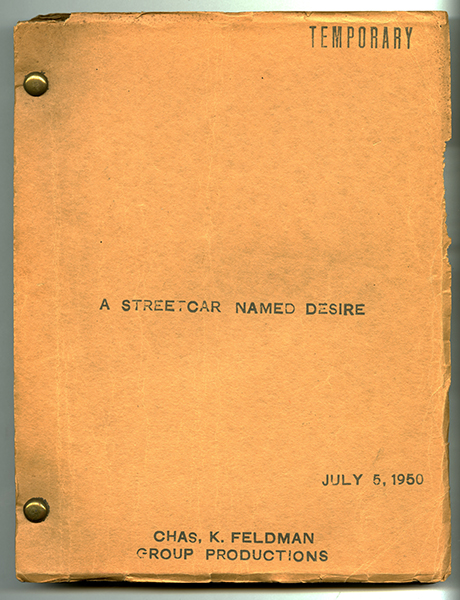
During the winter of 1944–45, The Glass Menagerie, a memory play about Williams’ family life in St. Louis, was successfully produced in Chicago and received good reviews. The huge success of his next play, A Streetcar Named Desire, in 1947 secured his reputation as a great playwright. Between 1948 and 1959, seven of Williams’ plays were performed on Broadway: Summer and Smoke (1948), The Rose Tattoo (1951), Camino Real (1953), Cat on a Hot Tin Roof (1955), Orpheus Descending (1957), Garden District (1958), and Sweet Bird of Youth (1959). By 1959, Williams had earned two Pulitzer Prizes, three New York Drama Critics’ Circle Awards, three Donaldson Awards, and a Tony Award.
Williams’ work reached worldwide audiences in the early 1950s when The Glass Menagerie and A Streetcar Named Desire were made into motion pictures. Later plays also adapted for the screen included Cat on a Hot Tin Roof, The Rose Tattoo, Orpheus Descending, The Night of the Iguana, and Summer and Smoke.
After the extraordinary successes of the 1940s and 50s, the 1960s and 70s brought personal turmoil and theatrical failures. Although he continued to write every day, the quality of Williams’ work suffered from his increasing alcohol and drug consumption, as well as from his often poor choices of collaborators. Williams died in 1983 in New York City at age 71 and was interred in Calvary Cemetery, St. Louis, Missouri.
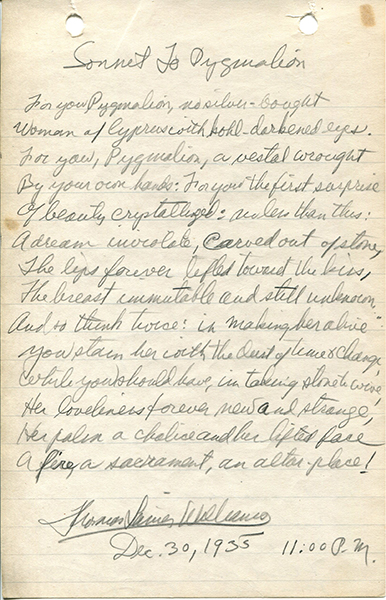
The Tennessee Williams Collection
The foundational materials in the Tennessee Williams Collection are related to Williams’ time at WashU: his Greek final examination blue book, manuscript and typescript poem drafts, and Williams’ University College grade card. Also included are several play scripts and film scripts, inscribed publicity photographs of Williams, correspondence from Williams, programs for Williams celebrations, and promotional materials advertising Williams’ play and film productions.
Tennessee Williams in Other Collections
More Tennessee Williams materials can be found across other manuscript and university archive collections, as well as among Special Collections cataloged items. See the Tennessee Williams Research Guide for further details.
Access these Materials
Search the Tennessee William Collection on the Archives Space
Contact
- Department
- Special Collections, Special Collections, Preservation, and Digital Strategies
- Name
- Joel Minor
- Job Title
- Curator of Modern Lit Collection/Manuscripts
- Email Address
- joelminor@wustl.edu
- Phone Number
- (314) 935-5413
Header Image Credit: Anna Magnani and Tennessee Williams on the Andrea Doria on the way to the United States to film The Rose Tattoo, September 1954. Photographer unknown.