
Preserving Documents of Freedom
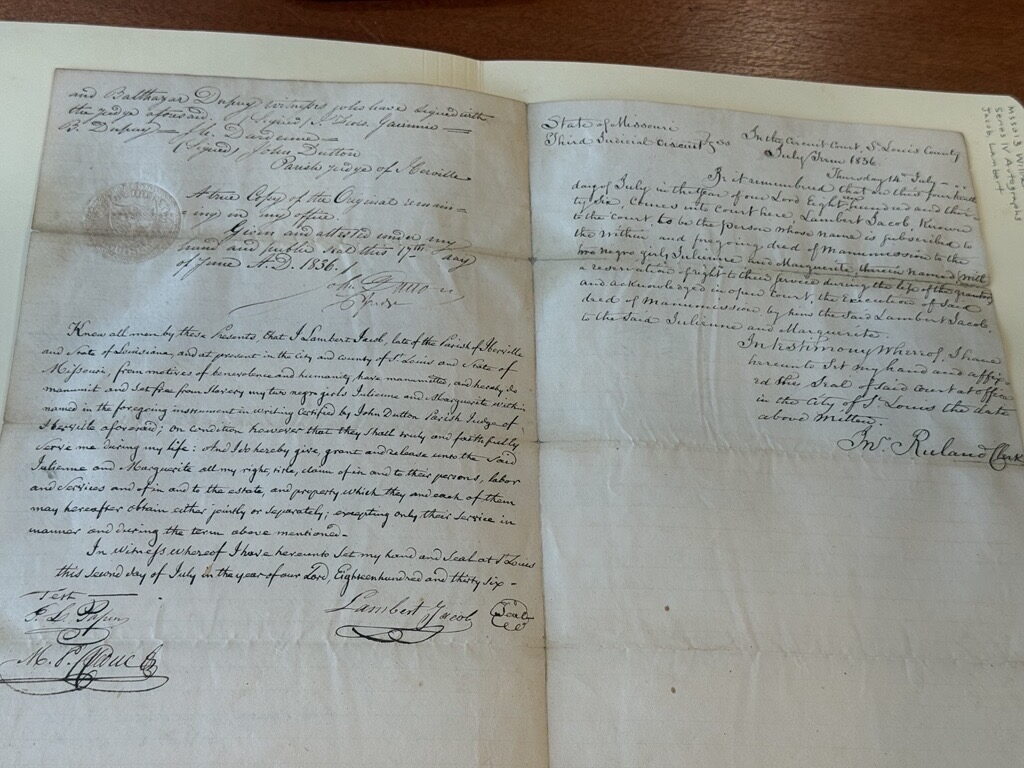
WashU Libraries acquired nineteenth-century emancipation deeds and other legal records related to slavery in Missouri as part of the William K. Bixby Collection. A prominent St. Louis railroad entrepreneur and philanthropist, Bixby donated a portion of his vast collection of literary and historical materials to the Libraries throughout the 1920s and early ‘30s. Among other things, the donation comprised a large autograph collection featuring celebrities and globally and locally significant figures, which explains Bixby’s motives in owning the emancipation deeds. Reparative Public Historian Kelly Schmidt explains that the documents were gathered with the specific intent of collecting autographs. The manumission papers were signed by well-known St. Louis judges and the enslavers or manumitters themselves, who were powerful and wealthy figures in Missouri. One of the emancipation deeds in the Bixby Collection was signed by John Cavender (1796–1863), who became a founding director and first treasurer of Washington University in 1854.
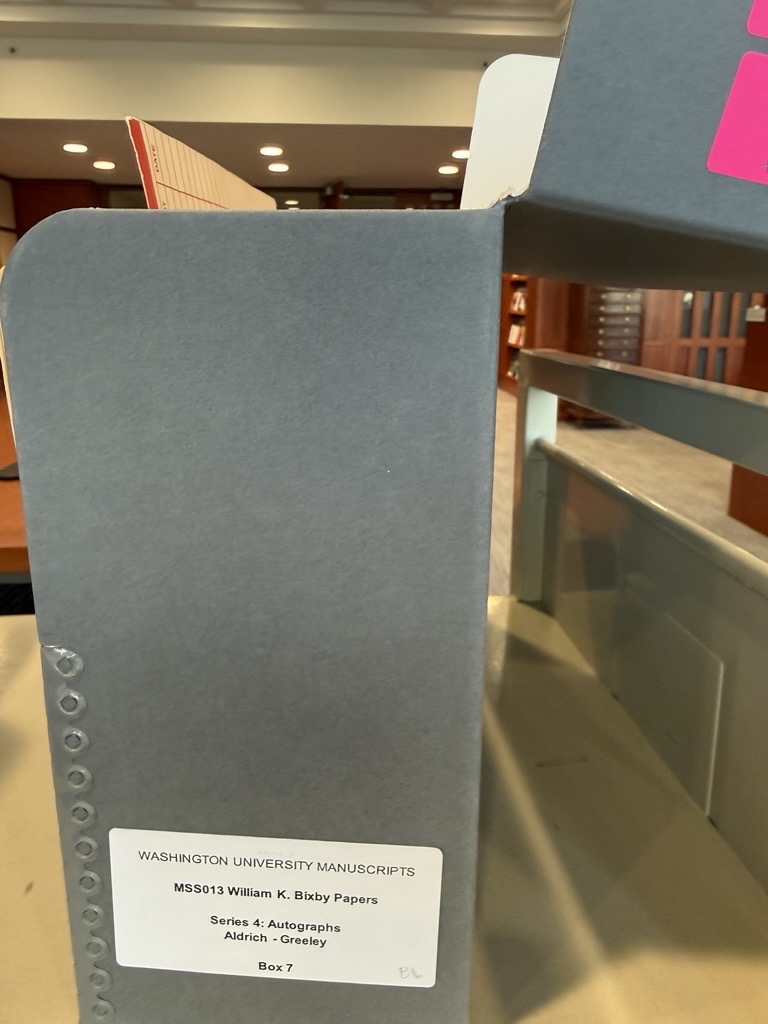
“Bixby was not collecting them because they were enslavement records, but they were saved and have survived. In the history of enslavement in the United States, so often these records get scattered and disconnected, so we can’t piece together the full story. The Cavender record, for instance, helps us better understand our university’s ties to slavery,” Schmidt says.
St. Louis’s complicated relationship with slavery and abolition is exemplified by the infamous case of Dred and Harriet Scott, an enslaved couple. who sued for their freedom before the Supreme Court in 1857 and lost. Historians estimate that between 1806 and 1865, about 300 people sued for their freedom in St. Louis courts.
Until slavery was legally abolished in Missouri on January 11, 1865, emancipation deeds were crucial legal documents that transformed enslaved people into free persons under state law. The deeds in the Bixby Collection record voluntary acts of emancipation in which enslavers or others formally freed enslaved people. Filed in county courts and authenticated with the court seal, formerly enslaved people often carried the papers with them, as they could potentially protect a free person from imprisonment and re-enslavement. However, freedom was conditional and precarious for Black Americans, and changing laws at this time carried the constant threat of enslavement. Emancipation papers created a legal right to freedom but did not offer absolute protection from re-enslavement.
Schmidt explains that by 1835, a formerly enslaved Black person in Missouri was required to carry a “freedom license” proving their freedom and legal residency in the state in addition to any free papers. These freedom licenses were secured by presenting documentation, such as an emancipation record, evidencing their freedom and legal residency in the state, and having a security testifying to the applicant’s good standing. Black Missourians caught without licenses could be fined, ordered to self-deport, or whipped. Patrollers and profit-seekers who apprehended Black Missourians without papers proving their freedom or legal residency could be treated as runaways and imprisoned or forced into slavery.
The 1850 Fugitive Slave Act renewed the threats of recapture of enslaved people who had escaped to freedom. An 1850 record of an escape, documented below in the Bixby Collection, illuminates the effects of the new federal legislation in Missouri on persons who escaped to freedom.
Conservation of Emancipation Documents
In 2025, emancipation deeds and other records of enslavement in the Bixby Collection were repaired and preserved for long-term use in research, classrooms, and exhibitions at WashU. The William K. Bixby III Family Rare Book Endowment Fund provided funding for the conservation. The historical papers were repaired and restored in a way that allows one to touch and observe the original document.
“In legal documents like these, you can clearly observe the watermarks, notary symbols, and court seals–details that are difficult to, if not impossible, to capture in a digitized copy. So, we like to give people the opportunity to interact with the originals because it has a greater impact on them,” said Danielle Creech, head of preservation, processing and exhibitions at WashU Libraries. One can still observe deep creases on the repaired emancipation deeds, which formerly enslaved individuals folded and carried in their pockets to prove their freedom and identity.
“From a conservation standpoint, you notice a lot of damage that speaks to how these documents were carried around. This was not something people put in a desk. You can still see the dirt and the yellowing around the folds showing the history of the way the document was used,” Creech said.
Four of the documents, ranging from the years 1836 to 1850, were made from early wood pulp paper, and one was composed of durable rag fibers, such as cotton and linen, Creech points out. Repeated folding weakens paper, especially wood pulp paper, and photo documentation taken before conservation shows the paper torn to pieces in several places, broken apart along the folds.
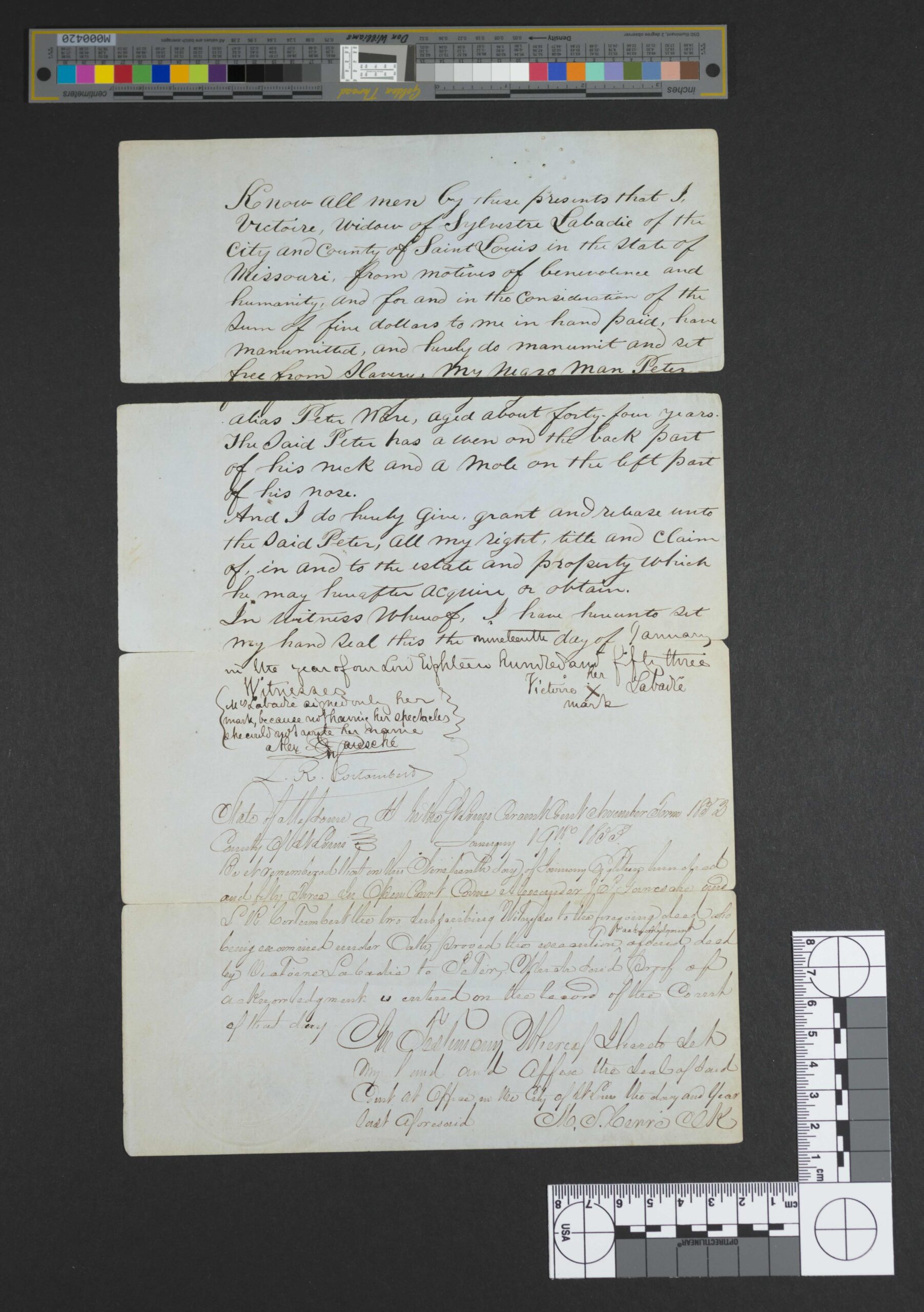
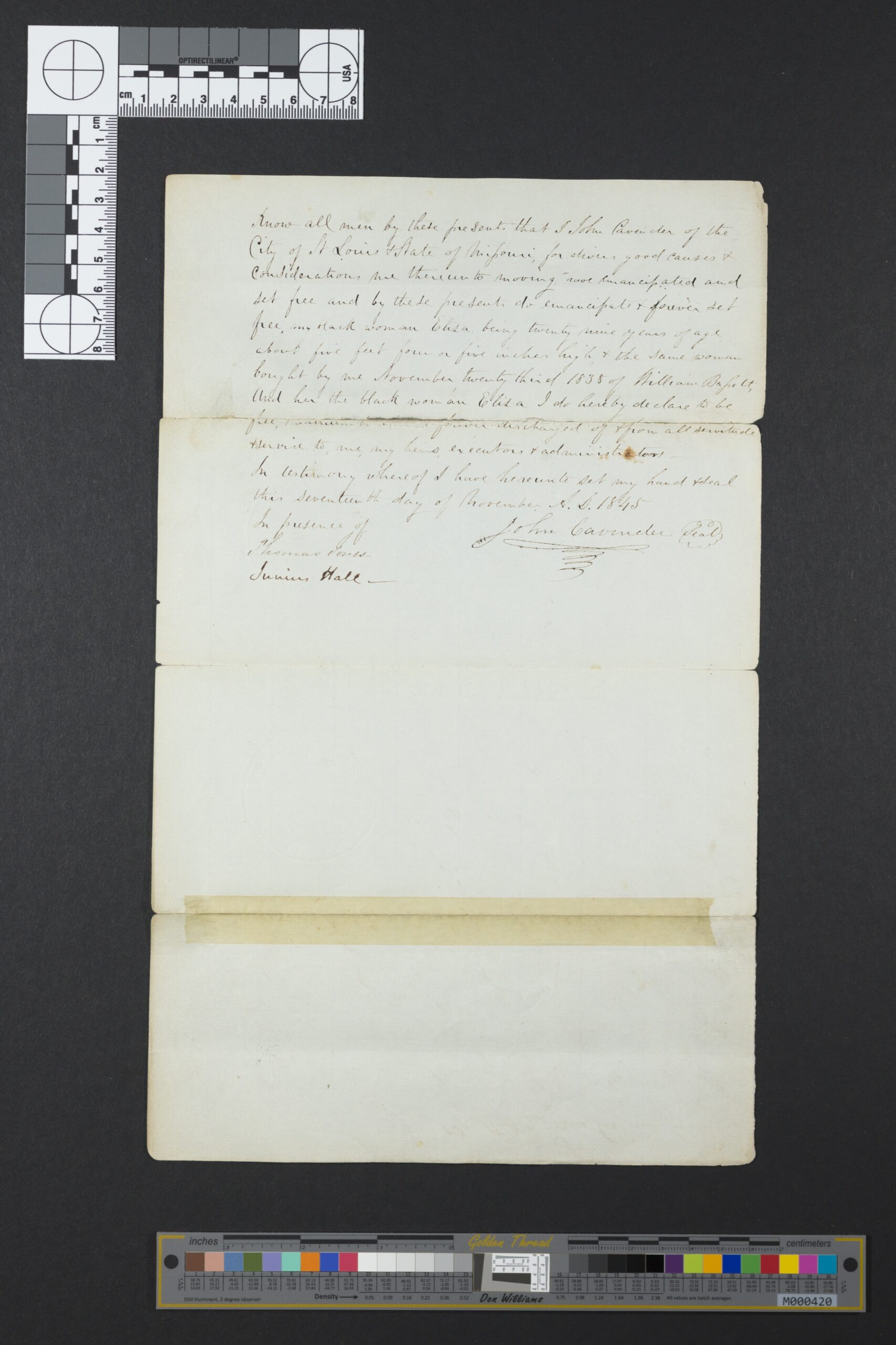
The second type of damage to these legal documents came from the type of ink that was used to write on them. Iron gall ink was the dominant writing ink in Europe and the United States from the Middle Ages through the nineteenth century. It was commonly used to write court records, deeds of emancipation, letters, and government documents. The mixture of tannins (extracted from oak galls), iron sulfate, and other elements used to prepare the ink leads to oxidation reactions and instability in the long-term, causing brittleness, fraying, and tearing of the paper underneath the ink.
Creech explained that the damaged documents were repaired with a widely used conservation method that involves covering the torn paper with Japanese tissue and rice starch paste. It protects the original document because the materials are stable, water-soluble, hence reversible, and durable over long periods of time. The extreme thinness and translucency of Japanese tissue allow writing to remain legible when applied over text.
In addition to the mending with Japanese tissue, the documents also underwent non-aqueous deacidification, a preservation technique used to neutralize acids in paper and prevent inks from bleeding. The emancipation deeds were sprayed with a magnesium-based alkaline compound to help stabilize the inks on them.
“It won’t completely stop them from breaking down, but it’ll slow the deterioration of both the paper and the inks considerably. So, these should survive for hundreds of years more,” Creech said.
Four emancipation documents and a record of escape for an enslaved individual were treated and conserved. Together, the emancipation papers and the record of escape calling for the apprehension of an enslaved person are valuable historical records showing shifting legal frameworks of Black freedom and enslavement. These include:
- A deed of emancipation from January 1853 for Peter Ware, co-signed by enslaver Victoire Labadie in Saint Louis County. The statement of manumission sets 44-year-old Ware “free from slavery…for and in consideration of the sum of five dollars.”
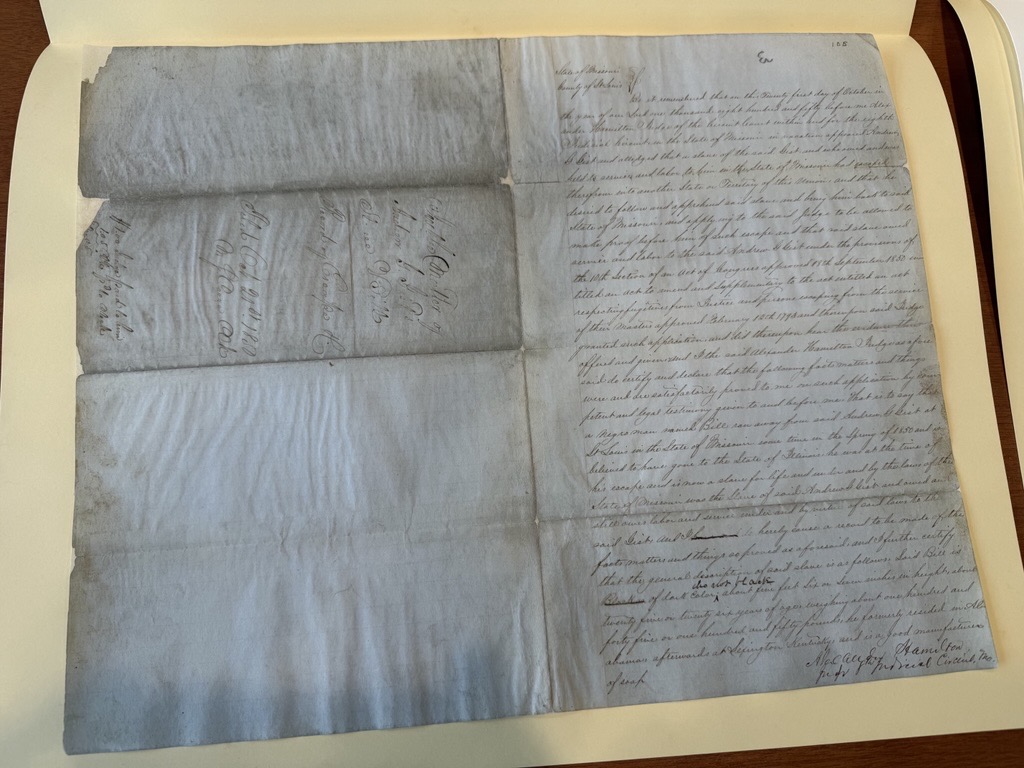
- An October 1850 court document recording the escape of Bill, enslaved by Andrew G. Gist, and signed by Alexander Hamilton of the 8th Judicial Circuit of Missouri. The latter, not to be confused with the Founding Father and the first U.S. secretary of the treasury, was a prominent judge in St. Louis during the pre-Civil War period and presided over the initial Dred Scott freedom suit. Following the example of other freedom seekers who attempted to reach states or territories where slavery was banned, the document states that the 26 or 27 year old Bill “ran away from said Andrew Gist…sometime in the spring of 1850 and is now believed to be in the state of Illinois, he was at the time of his escape and is now a slave for life…” Gist cites the Fugitive Slave Act of 1850 in creating a legal registration of Bill’s escape, which compelled Federal authorities and U.S. citizens to aid in capturing freedom seekers and returning them to slavery.
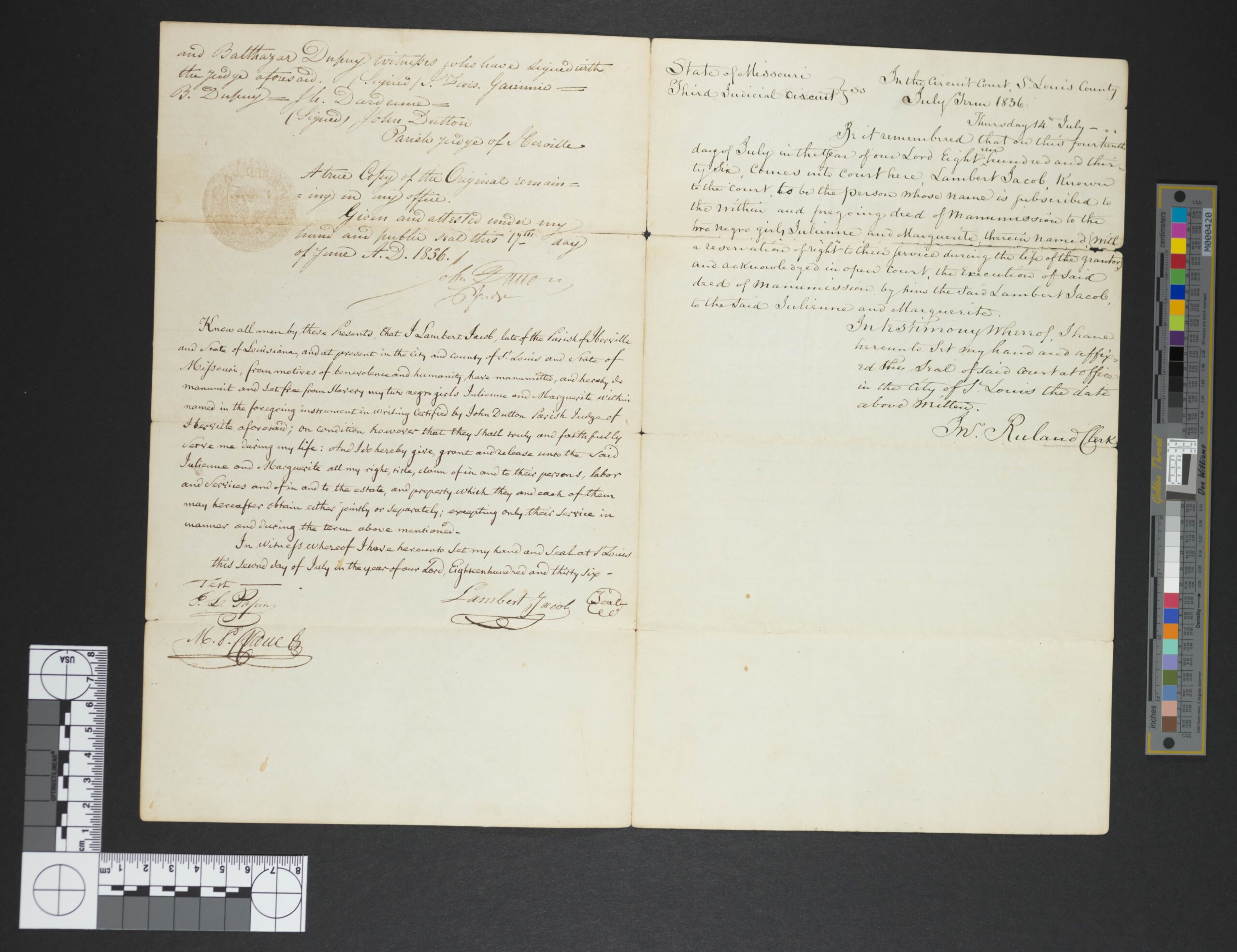
- A deed of emancipation, July 1836, for Julienne, age 38, and her daughter Marguerite, aged 6, signed by Lambert Jacob of St. Louis. The deed states that Lambert, as the highest bidder purchased Julienne and Marguerite and now grants emancipation from “motives of benevolence and humanity” in return for their continued service on the estate of Lambert Jacob during his lifetime. Lambert grants to Julienne and Marguerite the right, title, and claim of in and to their persons, labor in the estate, and property which they and each of them may obtain hereafter. A note is also included certifying this agreement from the State of Missouri, Third Judicial Circuit.
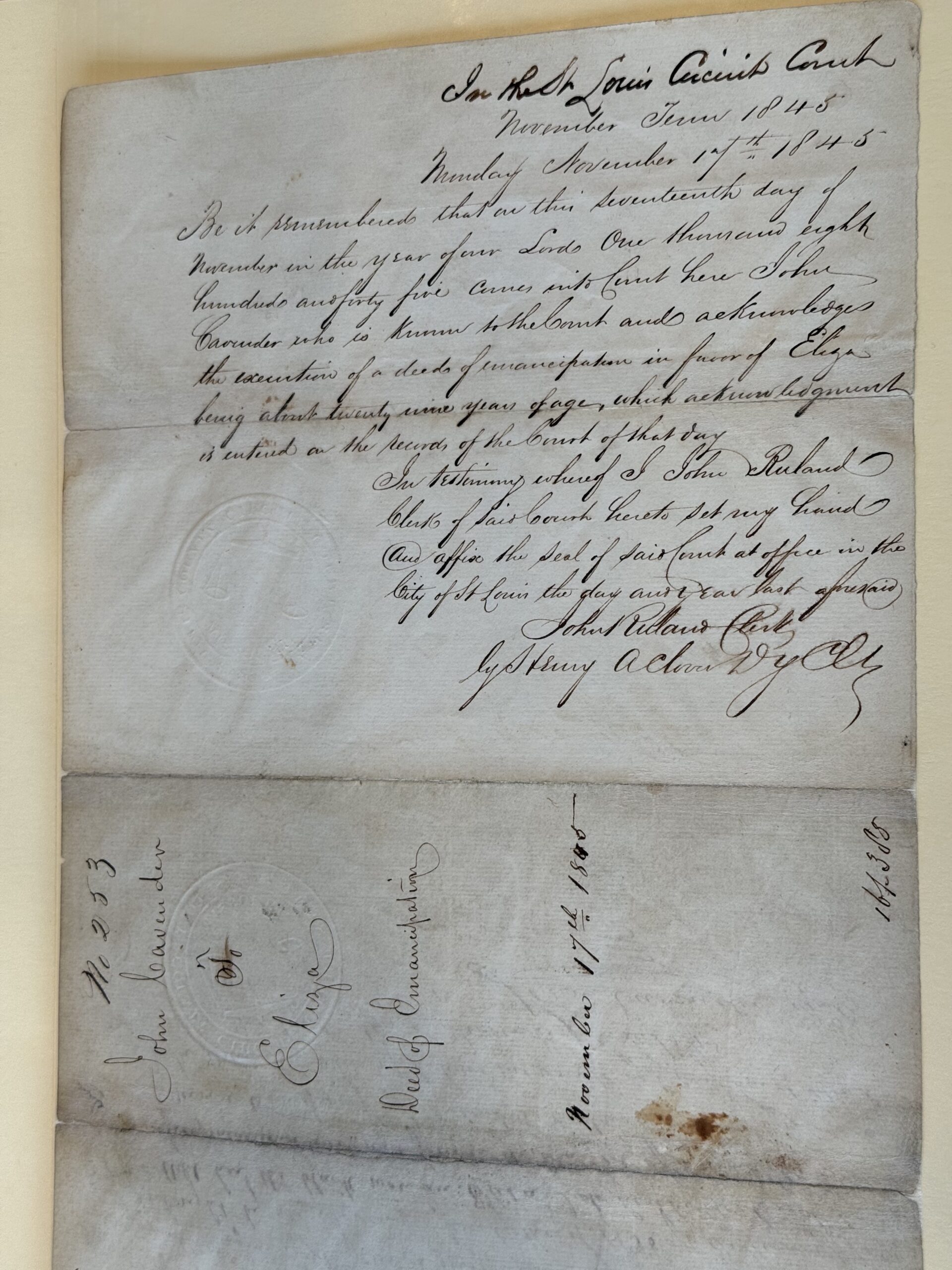
- A deed of emancipation dated November 1845, for an enslaved woman named Eliza, granted by John Cavender, and certified by the St. Louis Circuit Court. The brief document “acknowledges the execution of a deed of emancipation in favor of Eliza, being about twenty-nine years of age.”
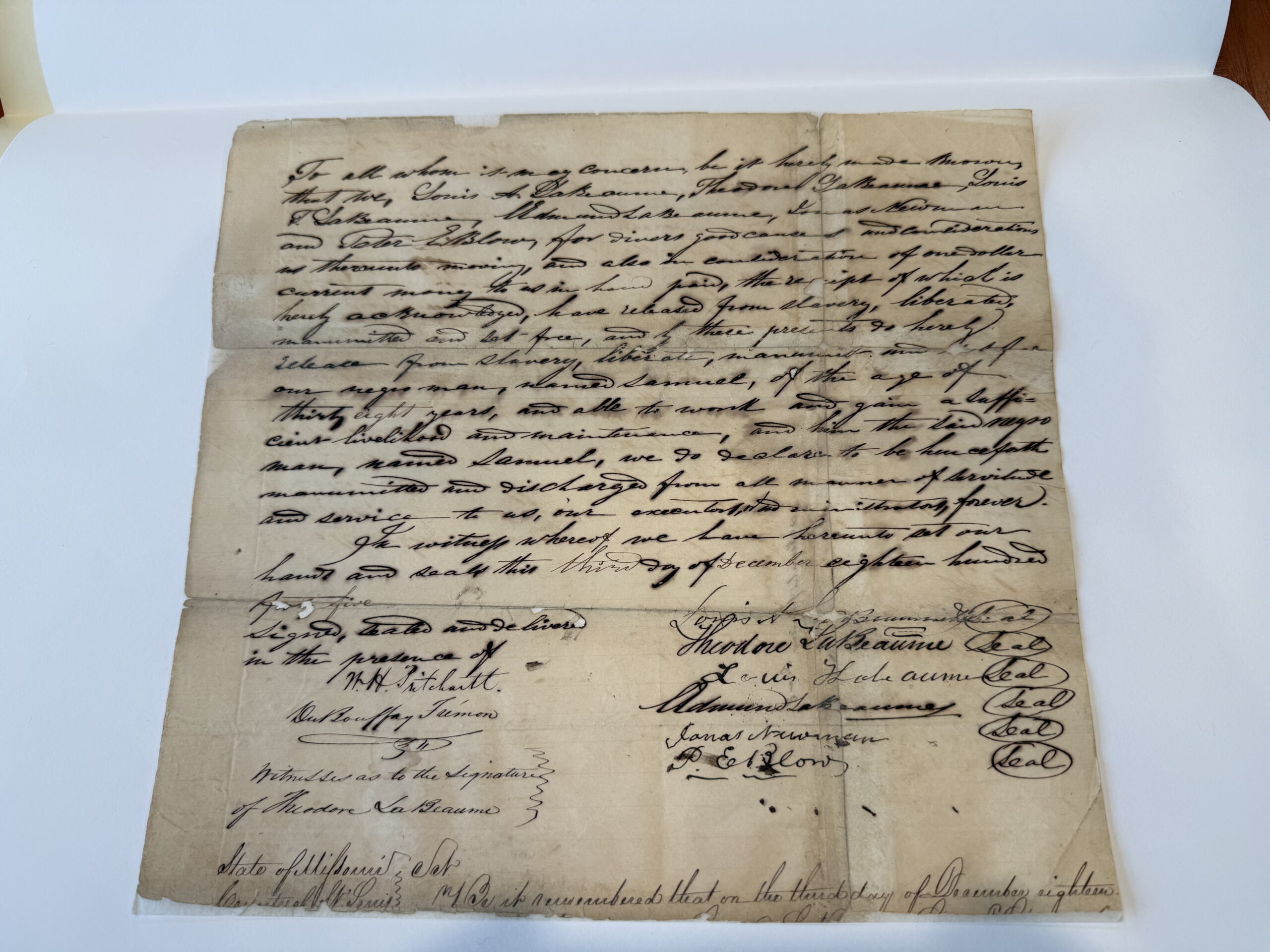
- Deed for emancipation for Samuel, December 1845, signed by Theodore La Beaume and others. The document states that the parties “in consideration of one dollar to us in hand paid” declare thirty-eight-year-old Samuel “to be free absolved, manumitted and discharged from all manner of servitude and service to us…”
Emancipation Documents in Classrooms and Public Programming
Emancipation deeds are powerful archival records that tell us much about the history of slavery in Missouri and its changing legal contexts. Written from the perspective of white enslavers and judges, they nonetheless preserve names and details, providing valuable insight into the identities of enslaved people.
“We can look at these documents and learn a lot about the people who were enslaved and freed by these documents. We begin to see how the internal slave trade in the United States works as people are pulled away from family and familiar places. We are familiar with the transatlantic slave trade and the middle passage, but the emancipation deeds show us there were middle passages happening in the U.S., in addition to revealing the ways enslaved people strove for their freedom. It’s so important that we preserve these records, because in the past they have been deemed not important and destroyed,” said Schmidt.
The preservation of these documents ensures that this history remains visible and teachable. The emancipation deeds in Libraries Special Collections have been in pop-up exhibits as a companion to the Archives of Resistance events each year. They are used in classes like “Slavery in Public History” and courses on St Louis and Black history to shed light on the culture of slavery and freedom in Missouri. The Libraries Student Public Historian intern, Tobeya Ibitayo, also utilized the emancipation deeds to create new forms of learning and engagement via digital exhibits and middle and high school history lesson plans.
The finding aid for the Bixby Collection can be found on ArchivesSpace. To learn more about the emancipation deeds, contact special collections.