
Library Instruction
Instruction & Information Literacy Program |
Special Collections Instruction & Class Visits | Why Information Literacy Matters
Instruction & Information Literacy Program
The Instruction and Information Literacy Program was developed to facilitate the expansion of information literacy instruction throughout the WashU Libraries across the WashU Danforth Campus.
The Instruction and Information Literacy Program’s mission is to facilitate a holistic approach to information literacy instruction by engaging the Washington University in St. Louis community through intentionally designed class sessions, assignments, workshops, and consultations where learners are introduced to the scholarly sphere, critical thinking, issues of access and privilege, and strive to achieve greater cultural awareness.
Jump to: Working with the WashU Libraries | Course Reserves | Including Library Instruction in a Course | College Writing Partnership with Information Literacy
Working with the WashU Libraries
WashU Libraries’ subject librarians, data services staff, and the Instruction and Information Literacy Coordinator can work with students and faculty to support their information literacy needs. Please see the Special Collections Instruction & Class Visits section for details on scheduling time in the Special Collections classroom.
If you are unsure who to contact, please reach out to Theresa Mastrodonato (tmastrodonato@wustl.edu) or Jodi Borgerding (jodieb@wustl.edu) for help in directing you to the correct area for instructional support.
Subject librarians are available for every discipline at WashU and can work with:
- Faculty to integrate research skills and information literacy concepts into their courses.
- Students (both undergraduate and graduate) are to assist with developing research and information literacy skills during their academic careers.
Contact the Subject Librarian who aligns with your subject area directly to schedule a class session, one-on-one research consultations, or other questions related to instruction.
Data Services Staff can assist students, faculty, and staff with research data management, data curation, data literacy, data wrangling, data visualization, and geographic information systems.
Data Services offers one-on-one consultations, research guides, and workshops. Contact Data Services directly for assistance with data.
Including Library Instruction in a Course
Library instruction can take many forms, such as a quick 5-minute introduction to the subject librarian for your course, a recorded video showing how to use a specific resource, a 50-minute in-person session, or an individual meeting with a subject librarian. Those who teach library instruction strive to make their sessions learner-centered and focused on developing lifelong information literacy skills.
Library instruction promotes student learning best when tied to an assignment with a research component. The most successful instruction occurs when faculty and librarians work together to plan research assignments, lessons, and learning outcomes.
While the types of instruction in the following list are the most common, please feel free to discuss your ideas with the librarian, curator, or data specialist. Additionally, working with your librarian, you can use a mix of instructional approaches in your classes. For example, you might have an in-person session and supplement it with several videos or a course research guide.
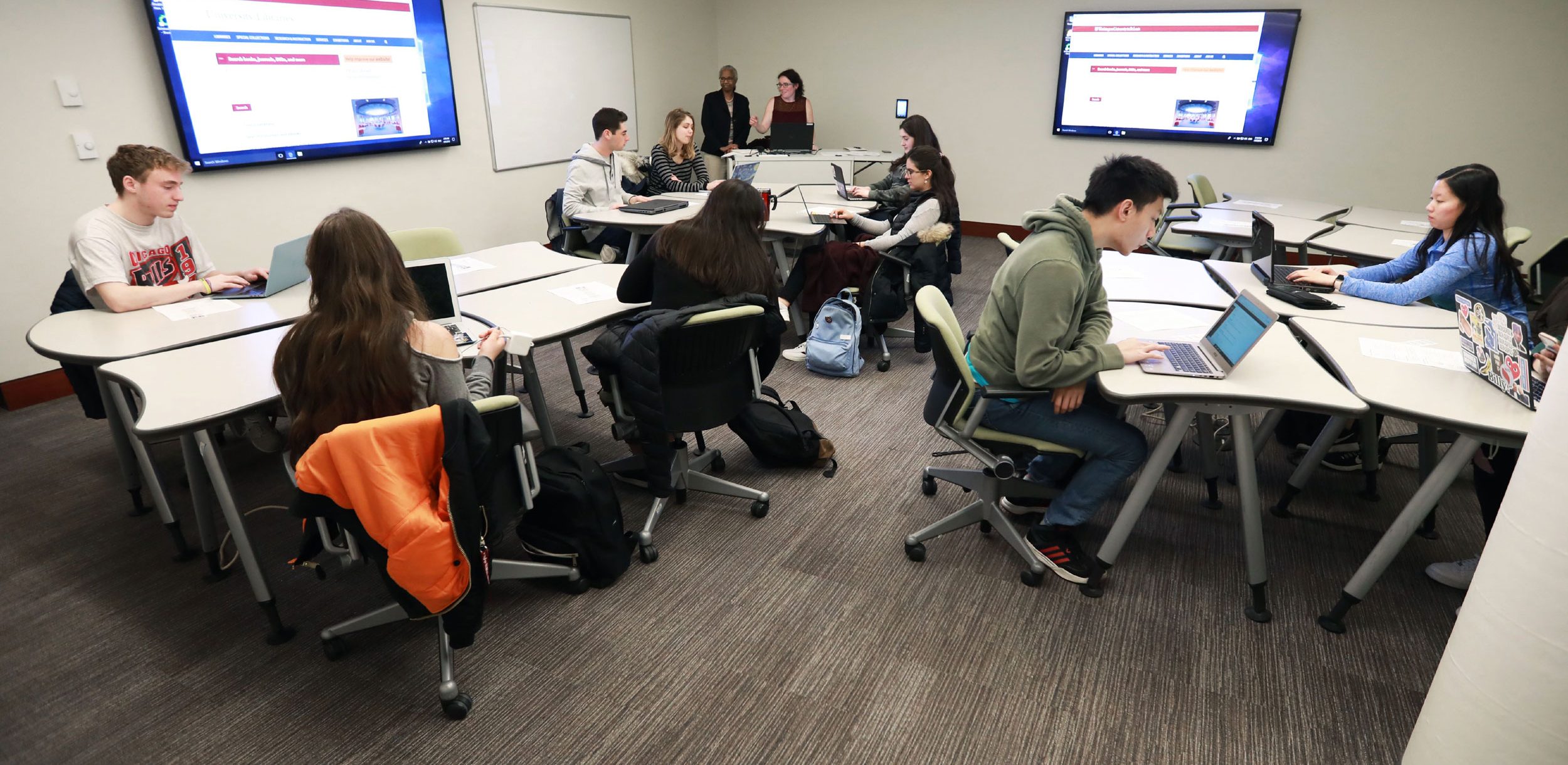
In-person instruction is traditionally how students are introduced to the Libraries. An in-person session can occur in one of the three instruction classrooms in Olin Library, one of the spaces in the departmental libraries, the special collections classroom, or the faculty member’s classroom.
If you would like your students to come to one of the libraries for an in-person session, please contact the librarian you are working with to schedule a space.
During an in-person session, the librarian can (but is not limited to):
- Demonstrate the use of online resources
- Discuss source evaluation
- Have students complete in-class active learning activities
- Provide homework for students to complete
- Utilize technology (examples: Poll Everywhere, Kahoot) to increase student learning
Instructional Spaces Within WashU Libraries
The Libraries offer several instructional spaces. If you have questions about these spaces or which might be best for in-person instruction for your class, please work with your librarian.
Olin Library Instructional Space
- Instruction Room 1 | Capacity: 16, furniture: movable – individual desks & chairs; equipment: 2 large monitors, laptop, sound system.
- Instruction Room 2 | Capacity: 26; the room can be divided into 2 (capacity side 1: 14, capacity side 2: 12); furniture: stadium seating – not movable; equipment: 2 overhead projectors, laptop, sound system, 26 desktop computers.
- Instruction Room 3 | Capacity: 38; furniture: movable – tables, chairs, individual workstations; equipment: 1 large monitor, laptop, sound system.
- Special Collections Classroom | Instructors must work with one of the special collections curators to utilize this classroom. Please see the Special Collections Instruction & Class Visits section for details on scheduling time in the special collections classroom.
Usage Policies for Olin Library Instruction Rooms 1, 2, and 3
- Instruction Rooms are reserved only by library staff for library programmatic and sponsored activities and are kept locked at all times.
- Instruction rooms are not intended to accommodate university faculty, staff, or student use without course-related or programmatic involvement by librarians or staff.
- Instruction Room 2 is accessible only to Libraries staff.
- Instruction Rooms 1 and 3 are accessible to anyone with a valid WashU ID. As study spaces, Instruction Rooms 1 and 3 are conducive to group study and can also be used by individuals.
- When not reserved by the Libraries, Instruction Rooms 1 and 3 are available on a first-come, first-served basis for studying during all library open hours. The WashU Libraries reserve the right to ask others to leave when the rooms are scheduled/reserved.
Departmental Libraries Instructional Space
Please contact the librarian you are working with at the departmental library to discuss the space(s) available for instruction.
The Danforth Campus departmental library locations include the East Asian Library, Kopolow Business Library, and the Kranzberg Art & Architecture Library. See the Study Rooms page to learn more about the departmental libraries’ study spaces.
Asynchronous instruction can take many forms, including but not limited to creating an asynchronous instruction module, embedding a librarian into a Canvas course, having the librarian create a video, or having the librarian create a Course Guide.
Asynchronous Instruction Module
- Faculty can work with librarians to create an asynchronous module to embed into Canvas courses. The module could introduce the Libraries and their services, or a lesson on a single concept (for example, evaluating sources).
- The best way to use an asynchronous module is as a flipped classroom – where students complete the module before class and then come to class prepared to discuss it.
Embedded Librarian
Faculty can embed a librarian into their Canvas course. To incorporate a librarian into a Canvas course, please contact the School Registrar and tell them to add the librarian(s) with the role “support, no grade book.”
After being added to a Canvas course, the librarian could:
- Create and monitor asynchronous discussion threads
- Post customized instruction videos in the course
- Post general instruction videos in the course
- Create an online quiz or another assignment to assess students’ learning of the asynchronous instruction component
- Encourage students to use our Ask Us! chat service
Video Tutorials
- Faculty can work with librarians to utilize videos for asynchronous instruction.
- Videos are a great way to show how to do a particular task.
- Working with a librarian, faculty can determine if a new video should be produced or if a preexisting video will provide the needed instruction.
Course Research Guide
- A course research guide can be developed as another form of asynchronous instruction.
- The course research guide can cover academic content areas, practical topics such as citing sources, and information specific to the course.
Synchronous instruction is similar to an in-person session because it is live, but it usually takes place via Zoom. Those who teach library instruction are available to schedule synchronous sessions.
Just like during an in-person session, in a synchronous session, the librarian can (but is not limited to):
- Demonstrate the use of online resources
- Discuss source evaluation
- Have students complete in-class active learning activities
- Provide homework for students to complete
- Utilize technology (examples: Poll Everywhere, Kahoot) to increase student learning
Formal library instruction occurs in a classroom or online (synchronously/asynchronously). However, library instruction can happen during a one-on-one session with a librarian. Individual instruction can be arranged by:
- Scheduling individual or small group research in-person or Zoom appointments with one of the subject librarians.
- Most librarians have a research appointment scheduling link; if the librarian you are looking for does not have one, check their research guide profile for contact information.
- Scheduling an individual session with the Data Services staff by completing the Appointment Form or through Zoom with the Data Services staff during Help Desk hours.
Beyond formal library instruction and setting up individual sessions with a librarian, the Libraries hosts many Research and Technology Workshops each semester.
Past sessions, descriptions, and recordings are on the Research & Technology Workshops Research Guide.
The Events Calendar will also list the workshops and other educational programs, such as faculty book talks and special collections curator talks.
College Writing Partnership with Information Literacy
The WashU Libraries partner with College Writing, which most students will take during their first year at WashU. This course serves as their introduction to research and library services.
Each College Writing section works with an individual or small group of librarians to provide more intimate, tailored guidance on college-level research.
The Libraries also maintain an online resource toolkit for College Writing faculty.
Special Collections Instruction & Class Visits
The Department of Special Collections offers faculty and students a variety of instruction and teaching opportunities. Curators support and collaborate with faculty to help students discover and engage with primary source material in our collections and will work with faculty to identify relevant material and resources.
Special Collections offers on-site instruction for the WashU community. In addition, our staff can work with faculty to teach remotely with synchronous classes or present material asynchronously.
Special Collections Instruction Sessions
Special Collections offers a range of instruction options and will collaborate with faculty to ensure class sessions meet learning objectives and allow students to explore unique archival and special collections materials. With materials for nearly every subject, Special Collections welcomes classes from all academic disciplines.
We encourage faculty or instructors to select the materials they would like to present in a classroom setting, or Special Collections staff can assist in selecting and introducing materials. If you are unsure if Special Collections has material relevant to your class, please contact us so curators can assist in identifying materials.
- A class session with an introduction or orientation to conducting research with archival and special collections material led by a curator or in collaboration with faculty.
- A class session on primary source literacy working with Special Collections materials led by a curator or in collaboration with faculty. Curators can guide students through the process of examining and interpreting archival materials.
- A curriculum developed in collaboration with faculty, which could span multiple class sessions to allow students to engage more with our unique primary source material from Special Collections.
If faculty are interested in digitization options for a class, please add a note when completing the Special Collections Instruction Request Form. A curator will contact you to discuss options. Please note that these requests are contingent on staff resources and time.
- Cyborgs in History: From Cybernetics to Artificial Intelligence (Collection areas: Manuscripts, Dowd Illustration Research Archive, Local History)
- College Writing I: Writing Identity (Collection areas: Rare Books, Manuscripts, Dowd Illustration Research Archive)
- Typographic Design (Collection areas: Rare Books, Dowd Illustration Research Archive)
- Artists in the Archive (Collection areas: Rare Books, University Archives)
- Children’s Picture Books: Culture and Content (Collection area: Rare Books)
- Campus Novels and Dark Academia: Stories of College Life (Collection area: University Archives)
- Media Archives: Political and Technological Interventions (Collection area: Film & Media Archive)
Schedule a Special Collections Class Visit
Complete the Special Collections Instruction Request Form to request a class visit or other study opportunities; please note that faculty must accompany their classes to sessions unless specific alternative arrangements are made in advance.
We request a minimum of four weeks’ notice, depending on the level of preparation required. Requests are allowed up to a year in advance, and class sessions can be scheduled Monday through Friday during Special Collections hours of operation. Class requests outside the usual department hours will be considered as staffing allows.
Please note that the form is a request. After the form is submitted, Special Collections staff will contact you to confirm when the classroom and requested materials are ready. If this is the class’s first visit, we require faculty to consult with the curator or archivist to help plan a successful visit and to confirm which materials will be used. We will make every effort to support your instruction needs.
Special Collections staff will respond to your request within five to seven business days. If you have any questions or concerns, please email spec@wumail.wustl.edu or call (314) 935-5495.
Class Locations
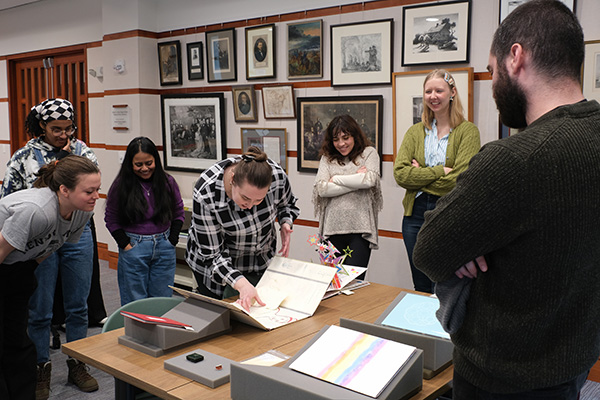
Our main space is the Mendle Classroom, adjacent to the Special Collections reading room in the John M. Olin Library. It can accommodate seminars, lecture-style presentations, or small groups at multiple study stations. The classroom capacity is 25 students; if your class size is larger, multiple sessions are available.
The Mendle Classroom has the following technology and equipment available for class use:
- Windows PC Computer
- Digital projector
- HDMI and USB ports and cords to connect a laptop
Additional meeting spaces in Olin Library are sometimes used at the discretion of Special Collections staff.
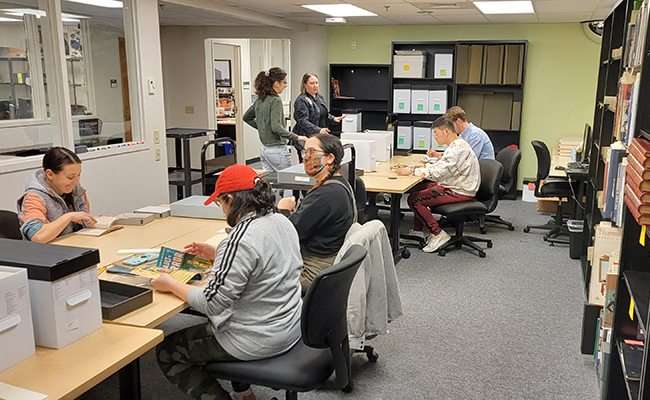
Located in the West Campus Building, the Dowd Illustration Research Archive (DIRA) room can accommodate 15 students to view materials in multiple stations or for a more extensive seminar. If your class size is larger, contact us for options. Classes working with collections from the DIRA will be held at West Campus unless otherwise arranged.
Why Information Literacy Matters
Higher educational institutions recognize that, in an age when information is created, disseminated, curated, and consumed 24/7, it is important to understand how to use it responsibly for professional and personal purposes. Academic librarians provide students and faculty with the knowledge, tools, skills, and behaviors needed to obtain materials in various media and formats to effectively find, evaluate, and apply relevant information to their studies, teaching, and research.
WashU Libraries defines information literacy as the ability to think critically about the production, communication, dissemination, and ethics of information in professional and personal settings. An information-literate person at WashU will:
- Believe in one’s ability to complete research
- Understand how to make inferences and use information as evidence to make an argument
- Use information ethically
- Understand how information is produced and disseminated and how those factors affect the authority of the source
- Investigate whose voices are missing or excluded from a conversation in a rethinking of what authority means